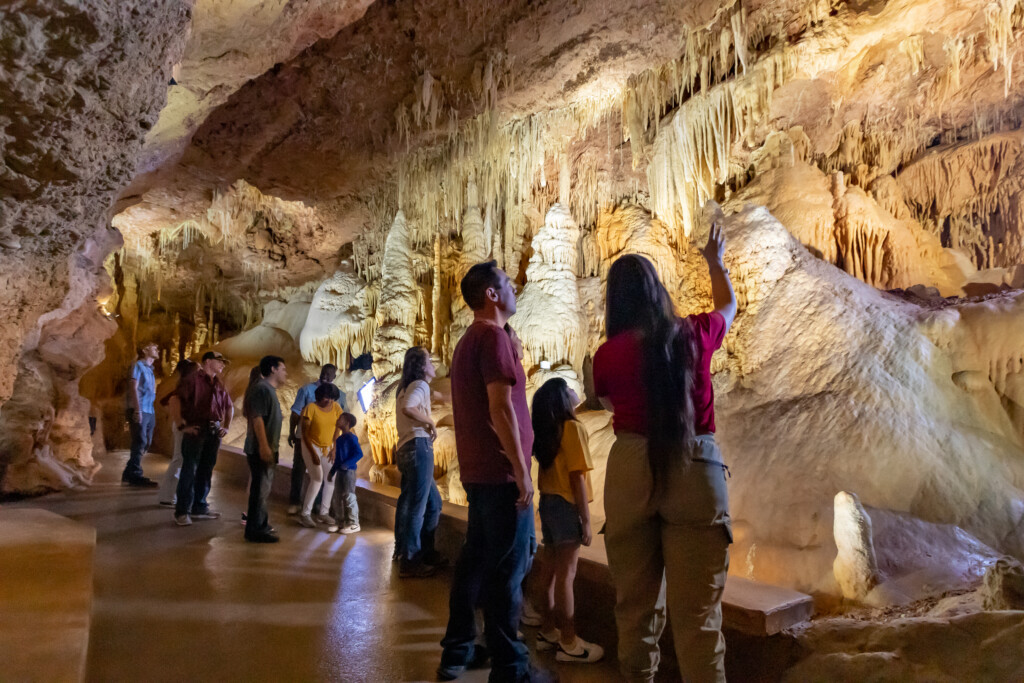
Taking stunning photos inside a cave is usually as easy as taking out your cell phone. Most modern cell phones have strong enough low-light settings which make it easy to catch the cave’s good side. It can be a little tougher to include yourself in the photo since our formations are carefully and artfully lit, and you standing in front of them are not. It’s a problem we usually solve by encouraging guests to use their flash or a second phone with a flashlight on to add your own spotlight.
The Cathedral Room’s colors are significantly more visibile thanks to the new lighting on the Hidden Wonders tour at Natural Bridge Caverns
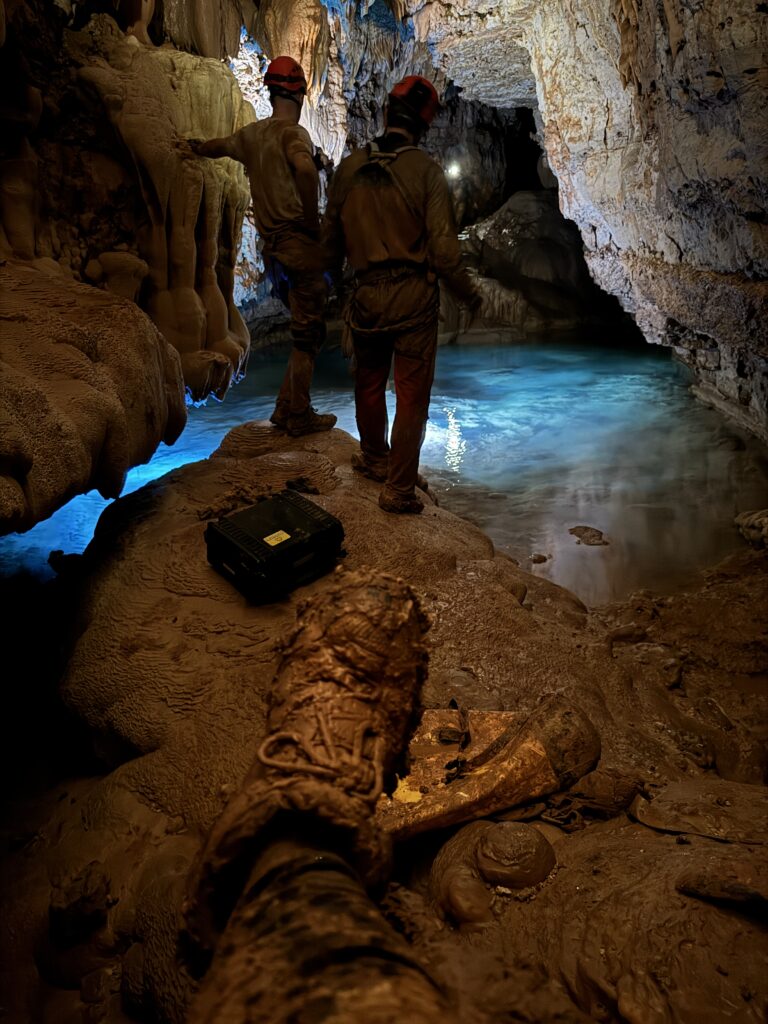
But when you go into the wild parts of the cavern system like our expedition team there are no multi-million dollar lighting systems showcasing the formations. Plus in our cave there is so much mud, it can be tough to get a clean shot (pun intended).
From a recent expedition to the Dome Pit. Note muddy boot in the foreground.
Fortunately we’ve worked with amazing professional cave photographers that have traveled the world capturing these incredible dark places and they’ve shared some tips and tricks for catching images deep in the dark underground.
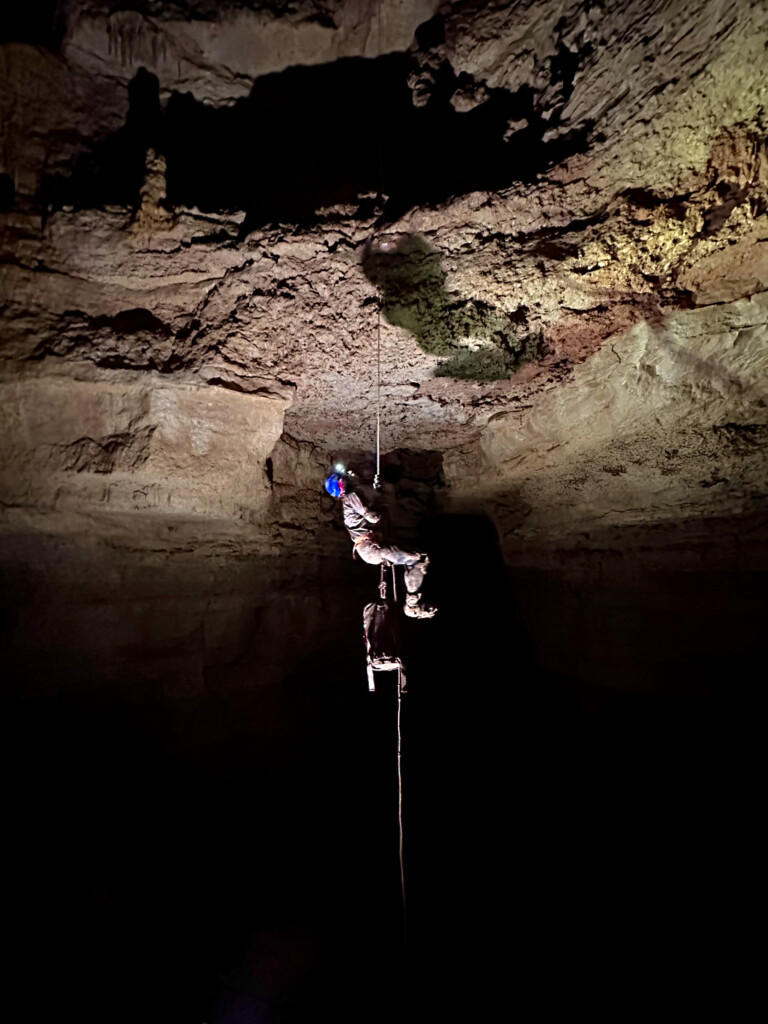
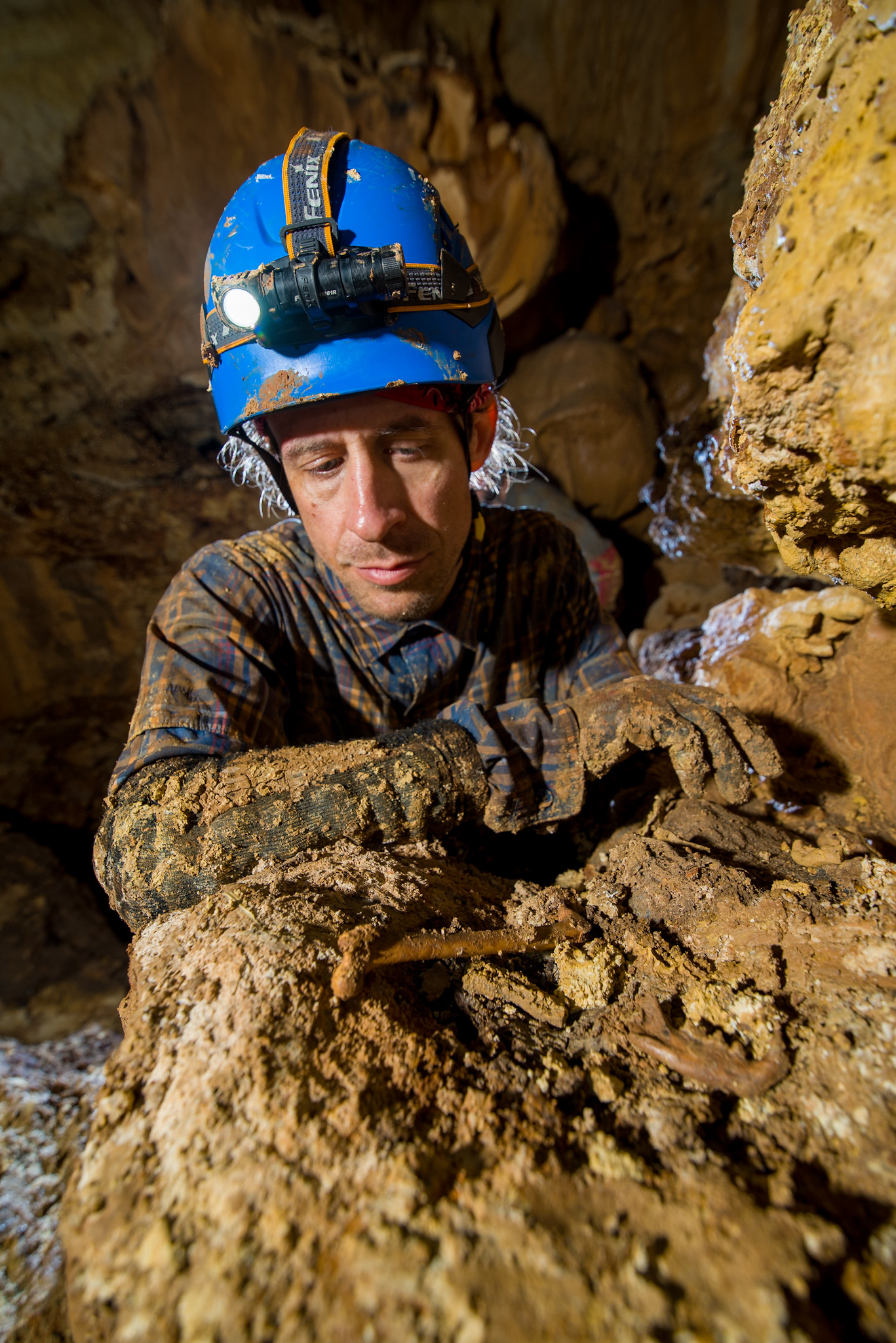
WildCat Expedition – Descending into the Cave to recover ancient wildcat bones. photo by Chris Higgins
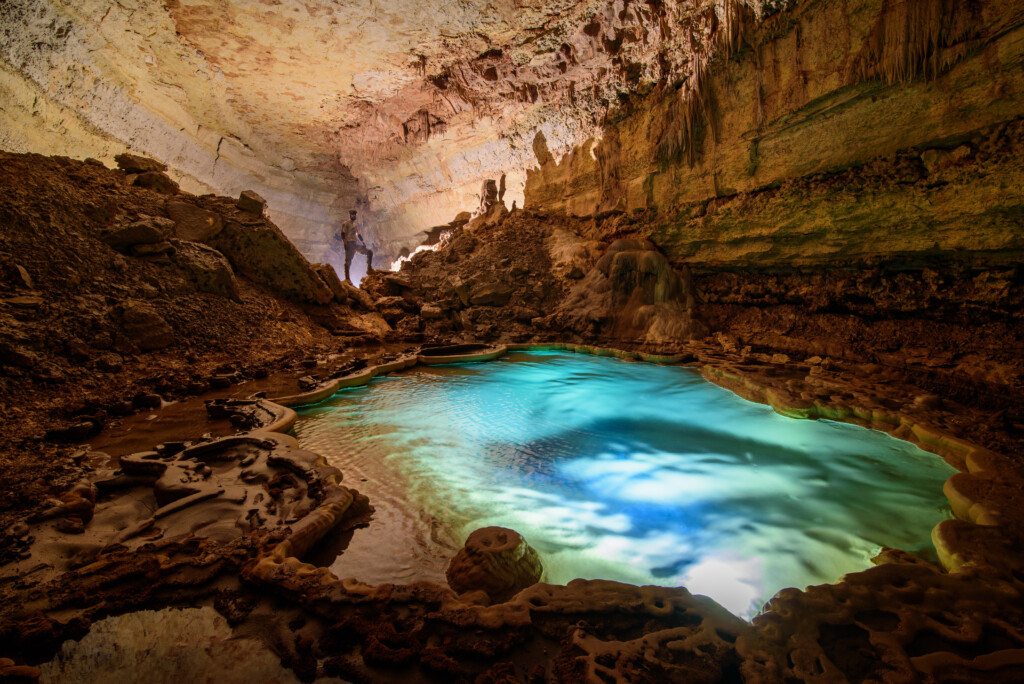
Stunning pool of blue water in the wild area of the cavern is in the foreground as a caver stands in the background. Photo by Chris Higgins
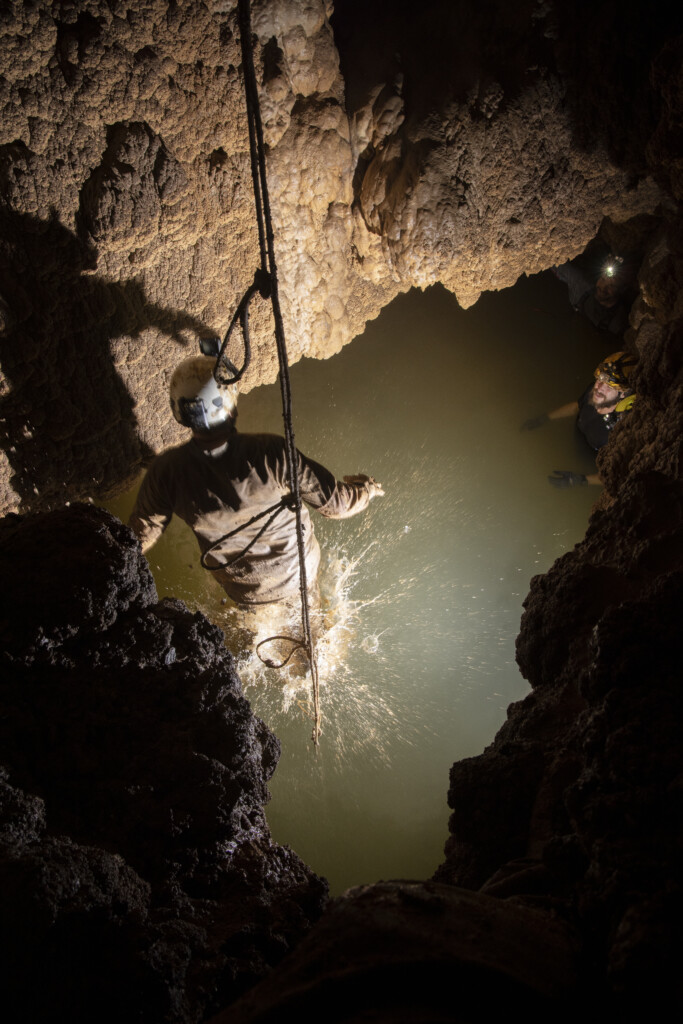
First you have to bring in lights. We carry in LED panel lights that are battery operated and capable of varying “warmths” which is rated on a Kelvin scale (fun article on that topic here). We also have smaller lights that can be placed under water which is critical to get a shot like the one above.
Travis Wuest jumps into the pool at the bottom of the northern passage.
Next you have to be an experienced caver to recognize cool moments that are there to be captured like this descent into a watery area. Having an artist’s eye for framing a shot helps too, with enough light to capture the splash, the dark cave and shadow drawing your eye to the action and another caver in the background for perspective.
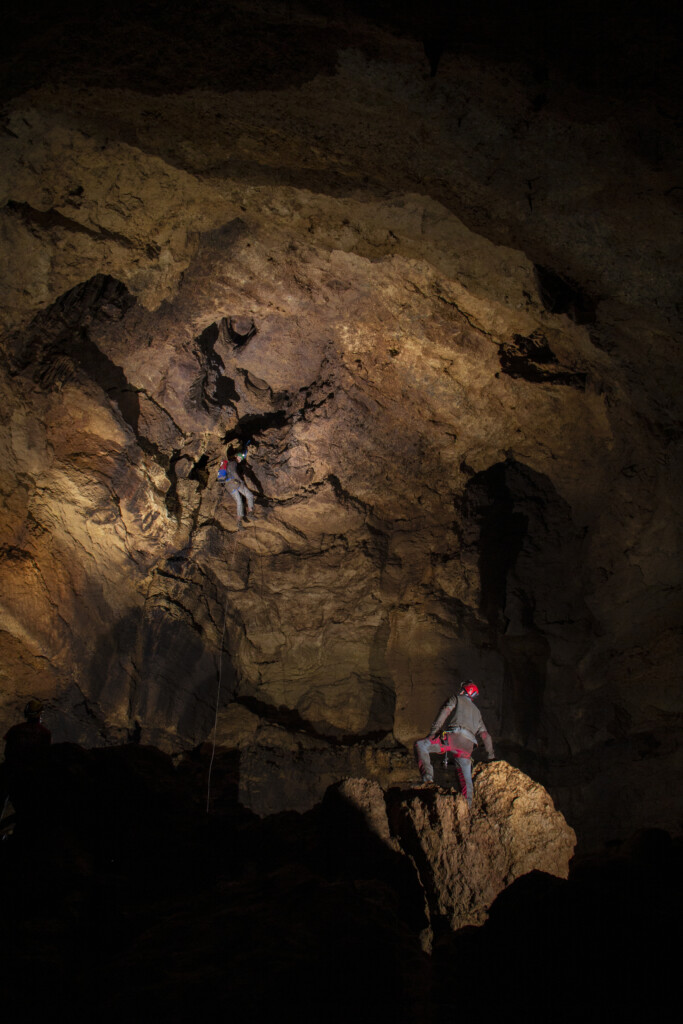
Brad Wuest watches as T. Dexter Soechting descends from the entrance squeeze into the room.
Next you need patience all the way around. Setting up lights takes time and getting everyone in the perfect position isn’t always easy. When you can “see” what isn’t quite there, you still have to paint (and repaint) the scene with light. Having a deep understanding of your camera’s capabilities is critical.
Skill, experience, a patient crew, and a beautiful cave. That’s all it takes! Curious about the wild areas of the cave? We do lead adventure tours through parts of it – learn more on our website.
Here’s a few more of our favorite shots from the wild areas in our cavern.
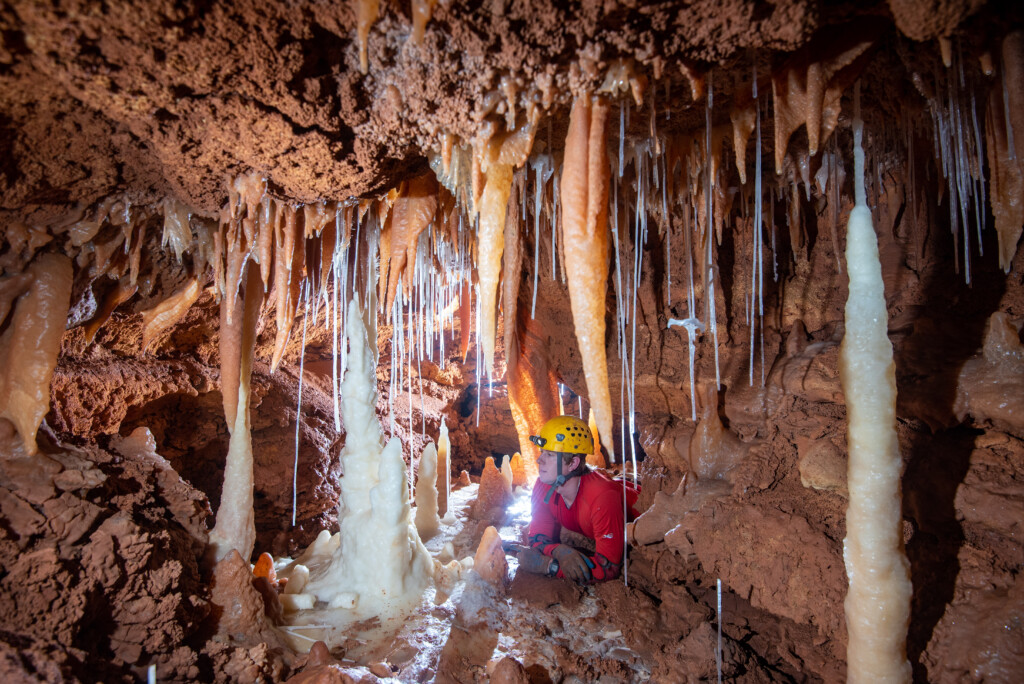
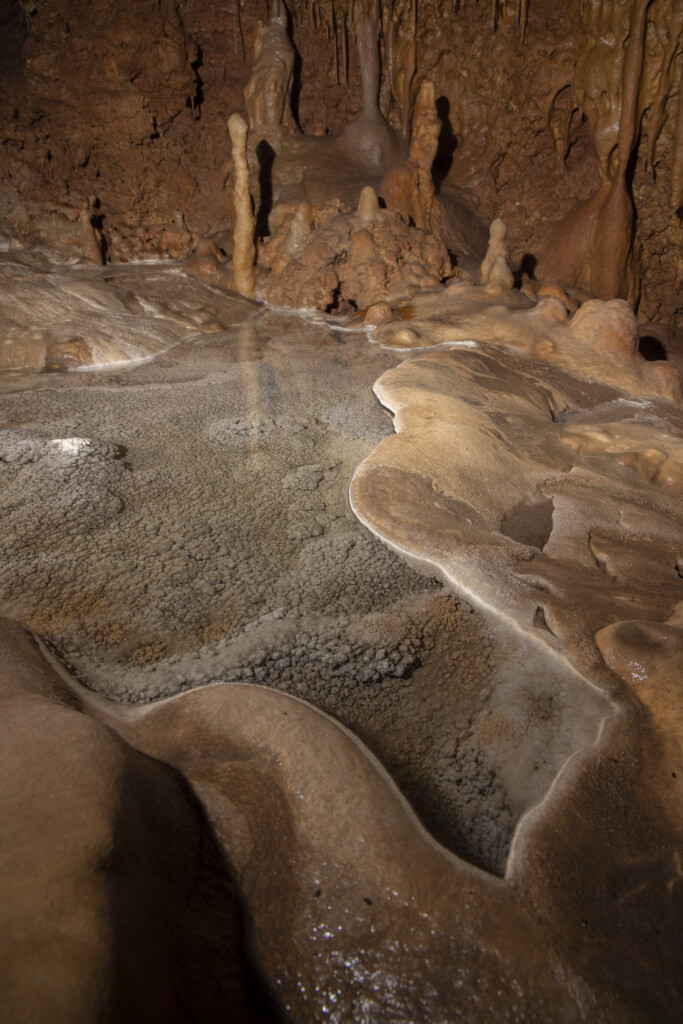
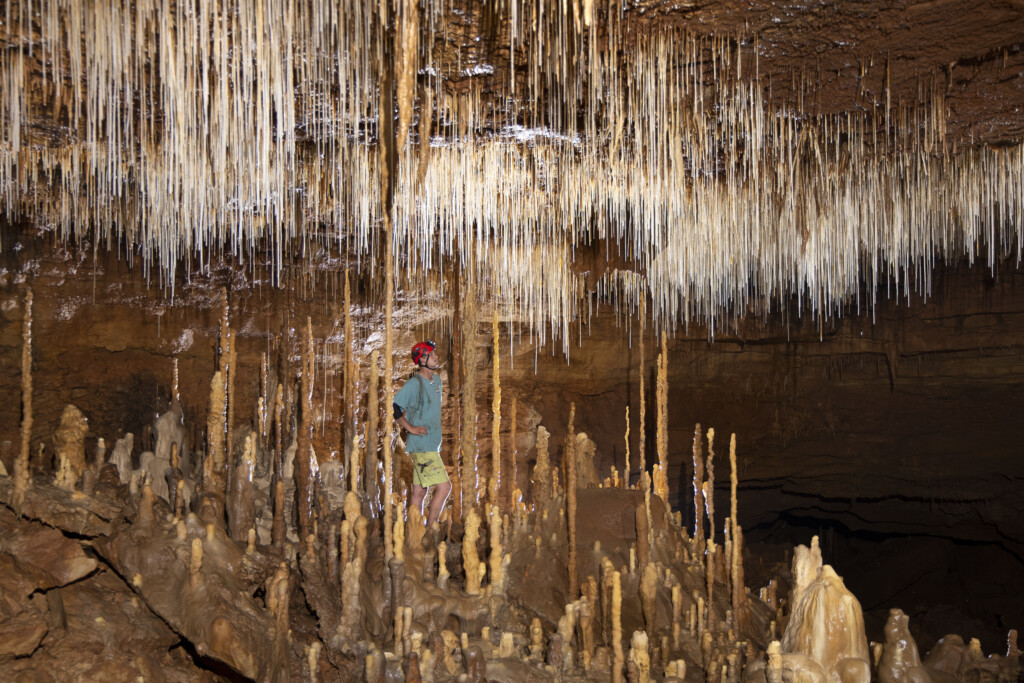
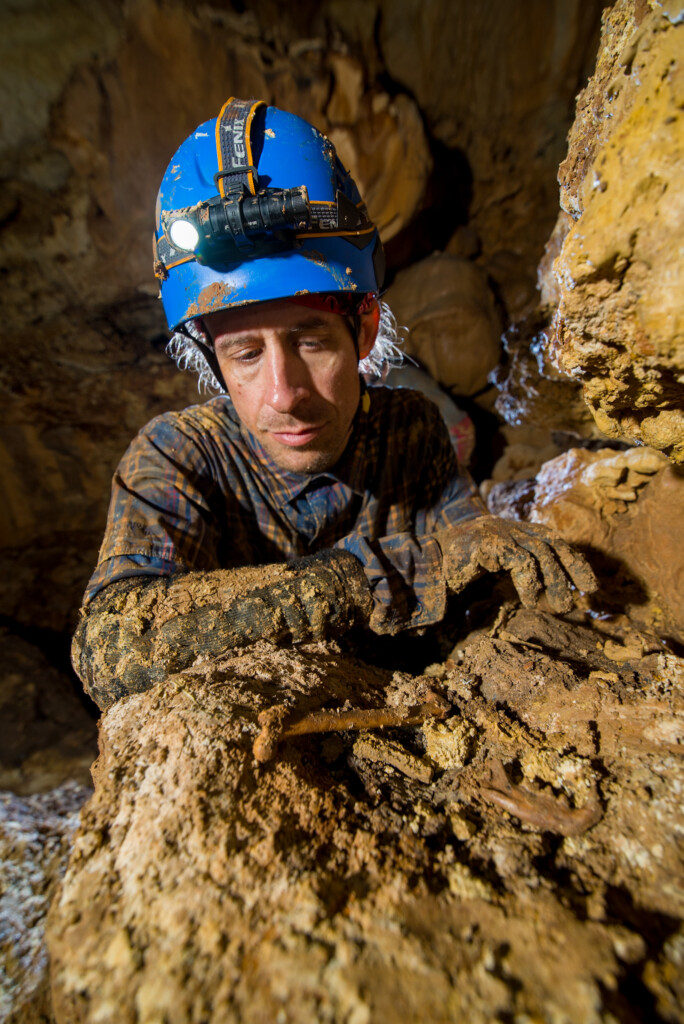
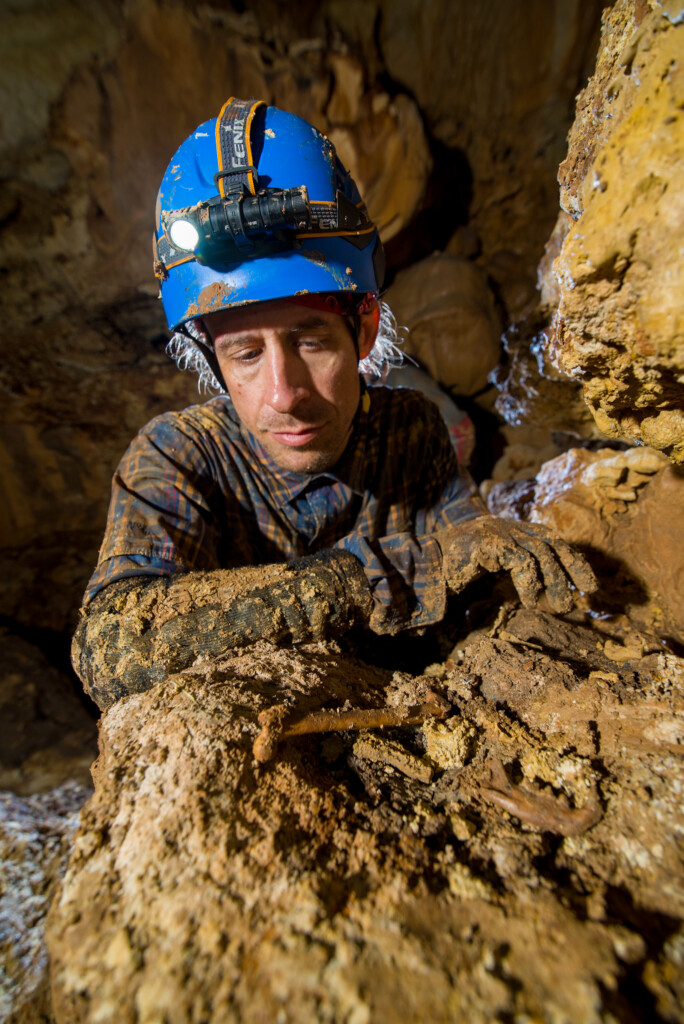
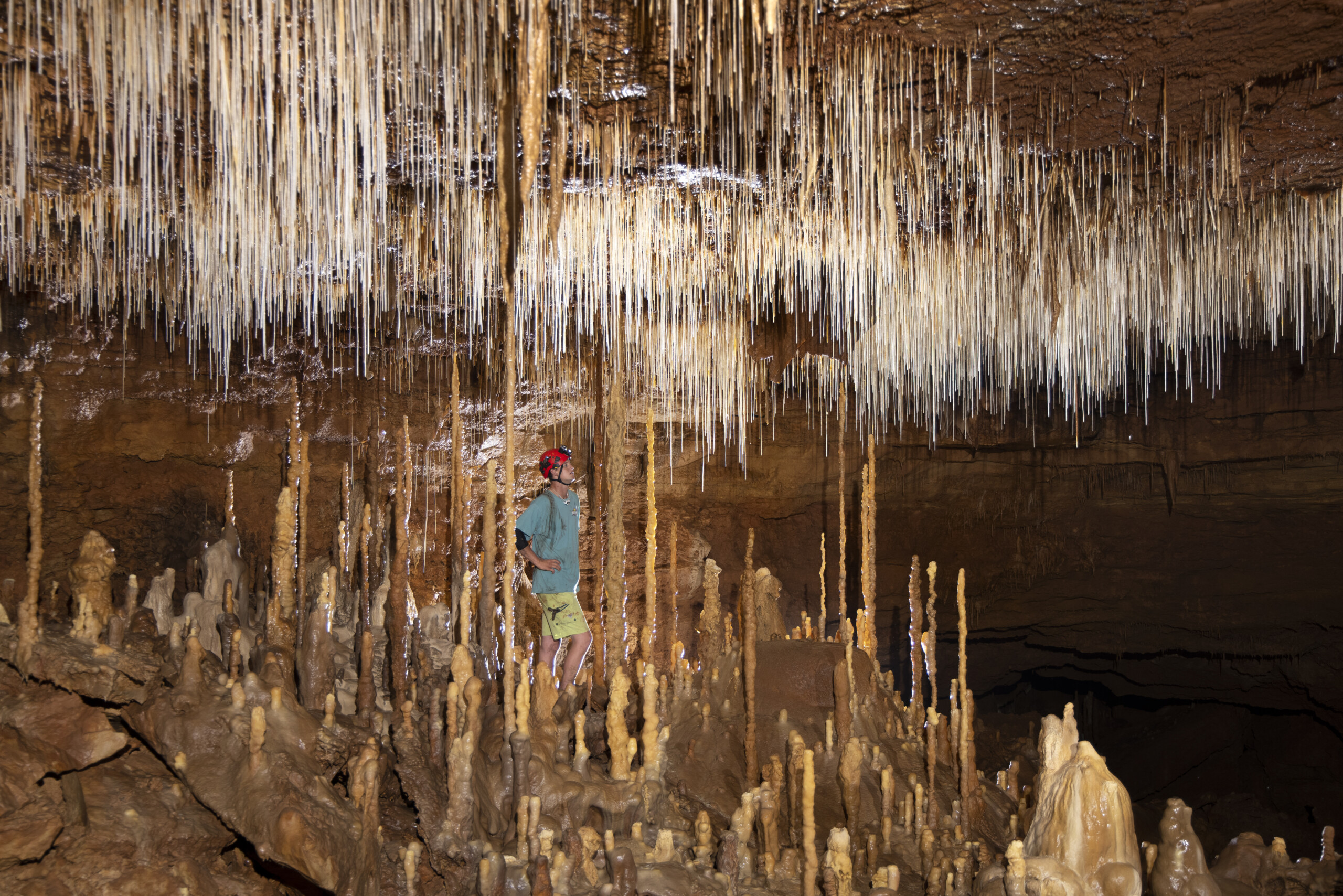
Searching for cave critters in the upper passage in a wild cave section of Natural Bridge CavernsFlowstone and pools at the end of the northern formation passage.T. Dex Soechting among the sodastraws and stalactites in the northern passage.J Morettie examining wildcat bones in Natural Bridge Caverns during Wildcat Expedition
Scientists Closing in on Answers About ‘Lost’ Prehistoric Cats of Natural Bridge Caverns – an update from the University of Texas at Austin
Last January, a team of cavers along with a paleontologist from The University of Texas at Austin rappelled into two deep chambers at Natural Bridge Caverns to retrieve rare fossil finds: the bones of two small prehistoric cats, each about the size of a house cat.
A year later, the bones of the Natural Bridge Cats are beginning to reveal their secrets.
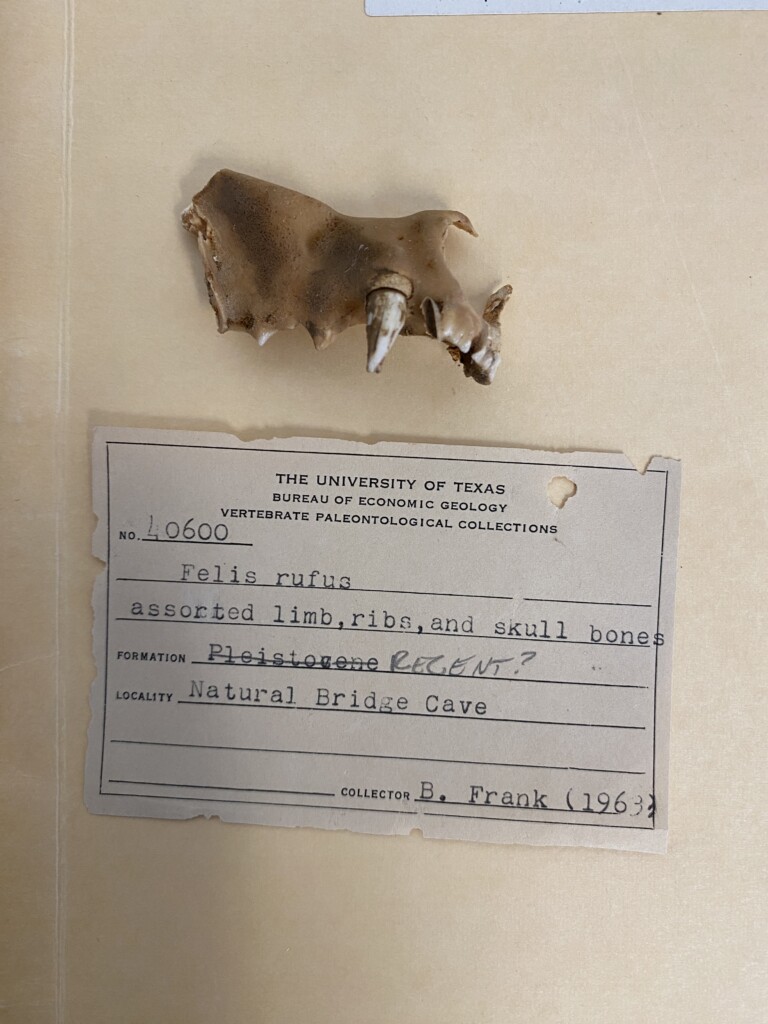
This is part of the original wildcat bone discovery from the 1960s found in Natural Bridge Caverns
Researchers have determined their age – about 11,500 years old – and have successfully extracted fragments of ancient DNA. They have also determined the cats are not a common bobcat, as was previously proposed, but likely a species of Neotropical cat, such as an ocelot, margay or jaguarundi.
“This puts these cats into a Neotropical group, which are all endangered today. Only ocelots are left in Texas,” said John Moretti, a doctoral student at the UT Jackson School of Geosciences leading the research. “This gets us into a really interesting group of cats – including a species that is now possibly extinct.”
Although the researchers don’t yet know what species of small cat slinked through the cave’s passageways thousands of years ago, they are closing in on answers.
Moretti is working with UT Assistant Professor Melissa Kemp, who is part of the Jackson School and the College of Natural Sciences, to apply state-of-the-art methods to prepare the ancient DNA fragments for sequencing that can definitively identify the cats. He is also conducting a systematic comparison of the bones from the Natural Bridge Cats to bones from Neotropical cats living today.
Ancient remains of Ice Age cats, recently discovered at Natural Bridge Caverns, offer scientists a rare glimpse into Texas’ prehistoric wildlife. These jawbones, carefully preserved and studied, help piece together the fascinating story of the region’s ancient ecosystem.
Discovering the cats’ identity could reverberate beyond the Texas cavern and popular tourist destination. The Natural Bridge Cats could serve as a literal skeleton key – providing a reference that could help with identifying the bones of ancient small cats around the world.
“They are prompting us to revisit questions about old specimens that have just been sitting on the shelf,” said Moretti. “Without them, there’s not an impetus to wrestle with these problems.”
The remains of the Natural Bridge Cats were found in two chambers called the Dungeon and the Inferno Room which are almost a mile from the current entrance of the cavern and 200 feet underground. Portions of the Dungeon cat were discovered in 1963 and brought to the UT collections for study and safe keeping.
John Moretti, with UT Jackson School of Geosciences, was part of the retrieval expedition at Natural Bridge Caverns
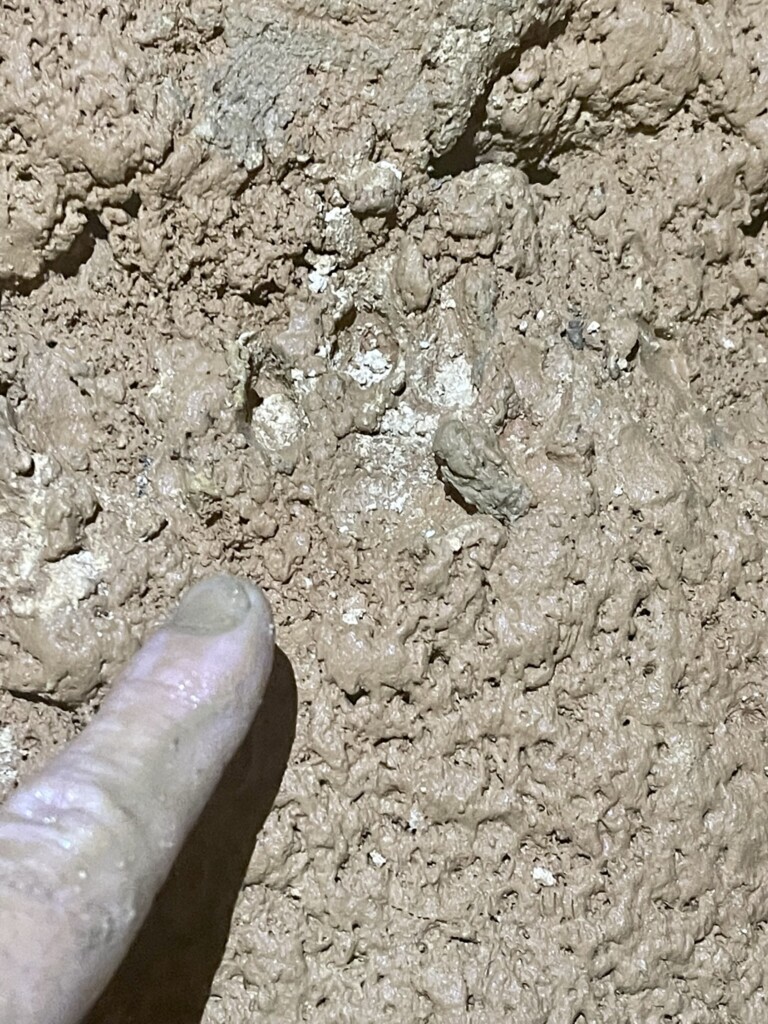
But in 2022, cavers discovered more cat bones in the Dungeon and a brand-new cat specimen in the Inferno Room. The openings into those two pit-like chambers are surrounded by small muddy pawprints that indicate it’s possible the cats fell into the chambers from above – and couldn’t get out.
“For decades, we’ve wondered about these bones – then we discovered the second cat. We have so many questions, including how these cats could have gotten so deep in the cave,” said Brad Wuest, president and CEO of Natural Bridge Caverns. “Discovery and exploration is at the heart of everything we do here at the caverns. Being involved with John and the team at UT Austin in this process of understanding more about the Natural Bridge Cats has been both rewarding and fascinating.”
In January 2023, Moretti led a recovery mission to bring the cats back to the surface after thousands of years underground. Research over the past year has helped to uncover some of the cats’ secrets.
Moretti matched the newly discovered bones in the Dungeon to the specimen sitting in the UT collections the past 60 years, showing that the two sets of bones came from the same skeleton. And two different dating techniques have placed the age of the cats in the ballpark of about 11,500 years ago. Radiocarbon dating on collagen extracted from the bones has the specimen at slightly older than that age. Uranium-thorium dating led by Jackson School scientists Staci Lowey and Alex Janelle on flowstone covering part of the specimen has it slightly younger.
But most important for figuring out the identity of the ancient cats is the successful extraction of ancient DNA. As expected, the DNA is in rough shape after spending thousands of years in a cave. But Moretti is hopeful about eventually being able to get a species identification.
“Like bones and other organic materials, DNA breaks down over time into smaller and smaller pieces,” Moretti said. “There’s still information stored in those fragments but it takes a lot of work to reconstruct and read the genetic code again.”
The DNA and collagen samples came from the Dungeon cat. The Inferno Room cat did not have DNA or collagen preserved. But based on the bones, Moretti thinks that what’s learned about one cat can be applied to the other.
“They’re the same shape and size,” Moretti said. “I feel confident that what we learn about the age and molecular identity of one skeleton is applicable to the other.”
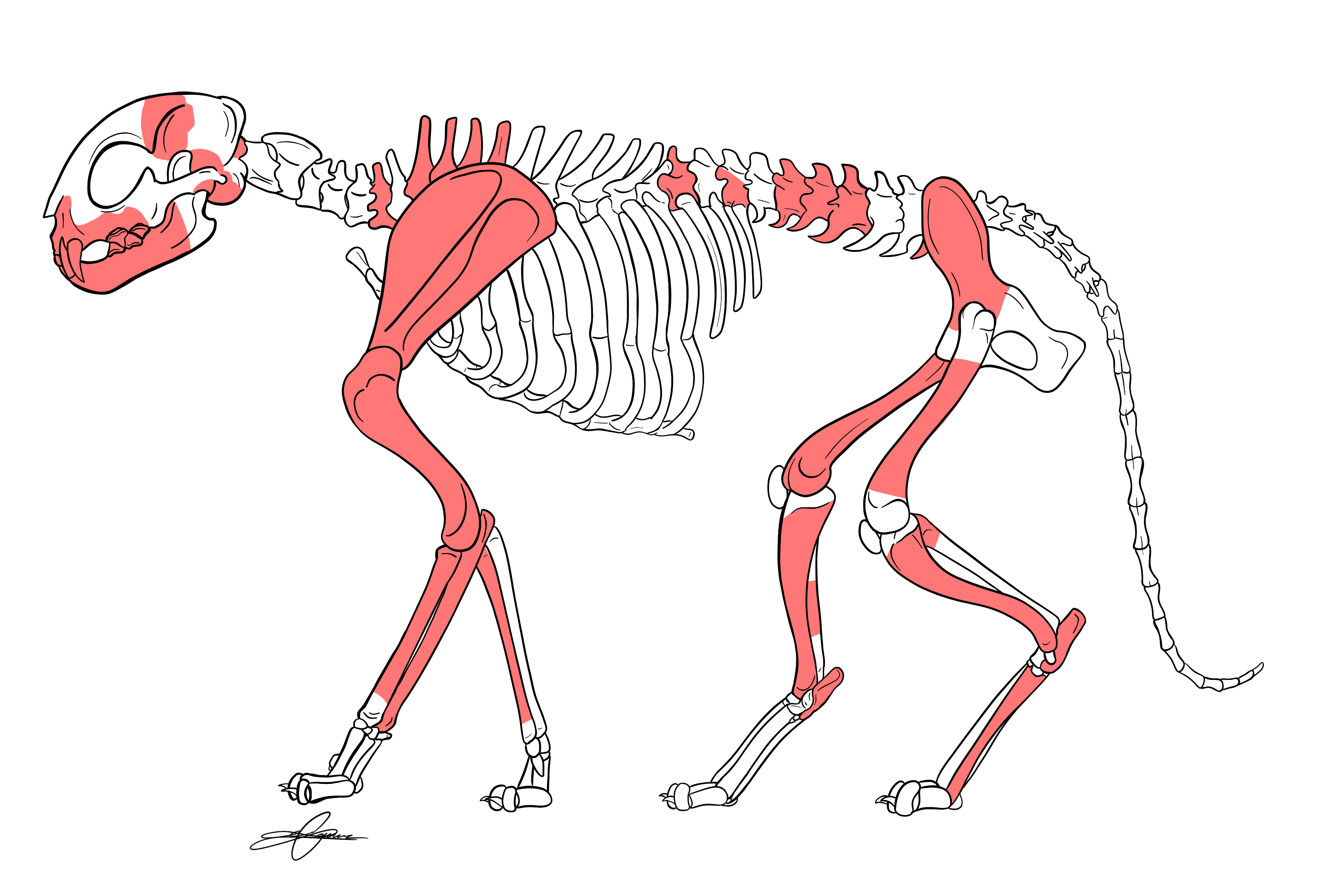
Having two ancient cats of the same kind found together – not to mention, with pawprints nearby – is incredibly rare. The cat from the Dungeon is the most complete specimen of a small Neotropical cat from the last ice age in North America. And together the two specimens make up a nearly complete skeleton with all its major parts in place.
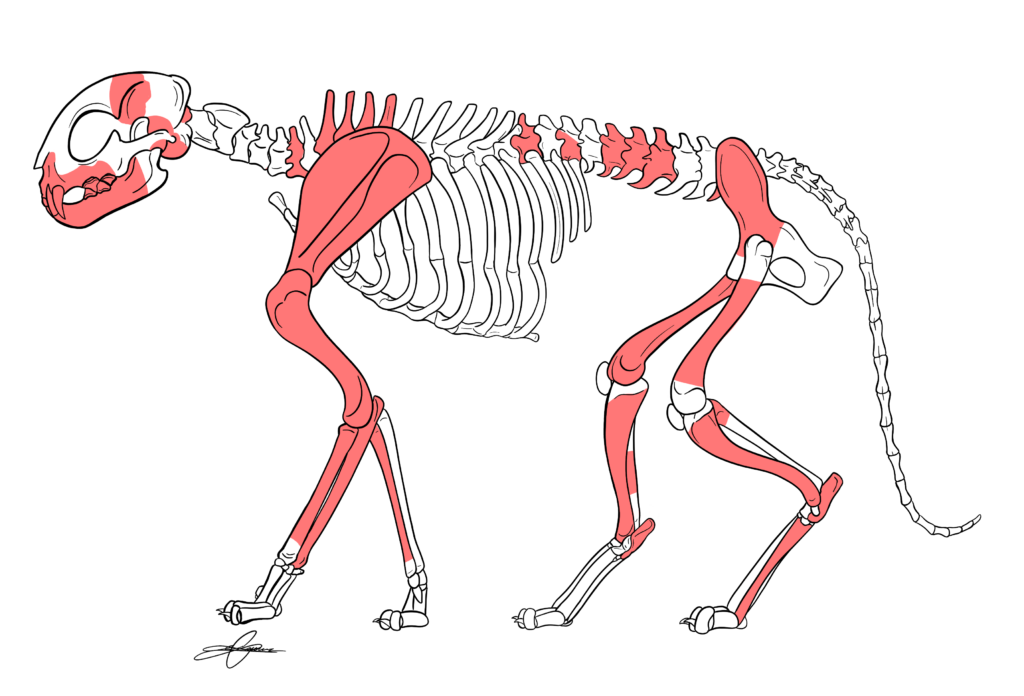
Illustration of the skeletal remains of an ancient cat discovered at Natural Bridge Caverns, estimated to be around 11,500 years old. The red shading highlights the bones that were found intact, providing valuable insights into the physical structure of this possibly extinct Ice Age feline.
If the Natural Bridge Cats can be definitively identified as a certain species, their bones could help with classifying other ancient cat fossils – which are notoriously few in number and look very similar to one another.
For example, the bones brought back from the Dungeon in 1963 were identified in the UT collection as belonging to a bobcat until the additional bones brought back by Moretti disproved that.
The new bones are also raising interest around an old hypothesis that the Dungeon specimen is an extinct species of margay called a ‘river cat.’ The hypothesis was proposed by Lars Werdelin, a world-renowned expert on extinct cats based out of the Swedish Museum of Natural History, who examined the bones while conducting a national survey of small wildcat fossils in 1985.
Moretti is closely comparing the bones of the Natural Bridge Cats to skeletons from margays and other Neotropical cats on loan to UT from other institutions to identify what’s natural variation versus a distinguishing anatomical feature.
The research team is also deploying a custom-built imaging device designed to capture high-resolution, 3D images of the cat tracks. Data obtained from those images will provide a way of testing if those ancient paw prints were made by the Dungeon and Inferno Room cats.
Ancient tracks of a wildcat found in the mud within Natural Bridge Caverns
But until the DNA sequencing results are in, he expects the Natural Bridge Cats – who are now together in the UT collections – to continue keeping their identity a secret.
Our deepest thanks to John Moretti and Monica Kortsha from UT Austin for this wonderful update on our cave cats – who may have had a tough final journey in the cavern, but who now live on in scientific study!
Blackland Environmental and Natural Bridge Caverns announce exciting results of a year long survey to celebrate Earth Day
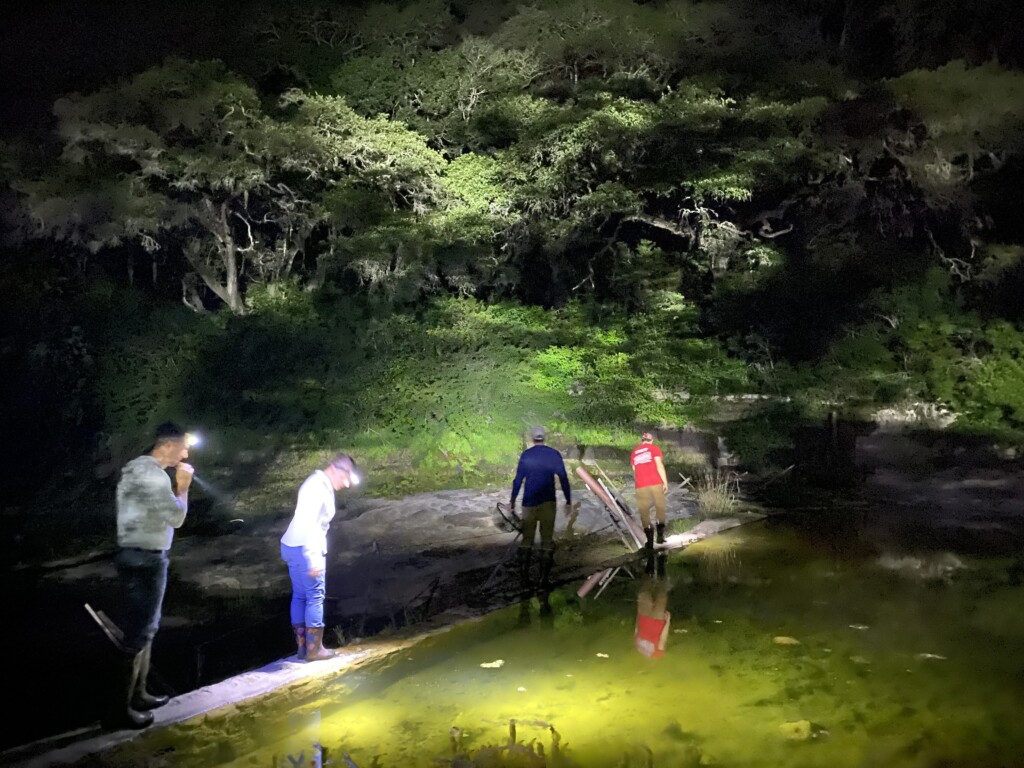
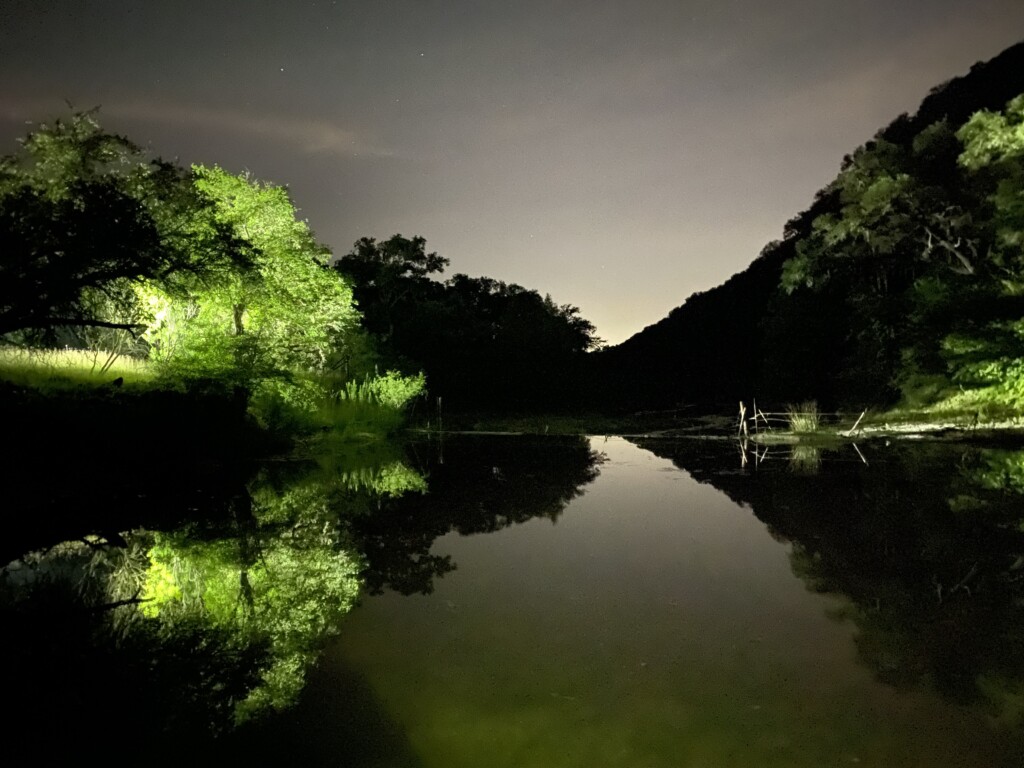
The land surrounding Natural Bridge Caverns is hopping with a diverse set of frogs according to the results of a recently completed environmental survey. The yearlong effort by the Wuest family and Blackland Environmental identified ten different species of frogs including the Cliff chirping frog, Cope’s gray tree frog, and the spotted chorus frog – to name a few “anurans.” Anurans, which are amphibian species including frogs, toads, and tree frogs, are the most diverse order of amphibians documented across the globe in a wide array of habitats. Local volunteers joined the hunt over the last year, armed with flashlights, recording devices, and muck boots.
“To find this diverse number of species just a few minutes’ drive from the urban areas of San Antonio is remarkable,” said biologist Jeremiah McKinney, operating manager of Blackland Environmental. “These results highlight the importance of the aquatic and semi-aquatic habitats as they clearly support a wide variety of species.”
Counting frogs is an excellent measure of the health of an eco-system. “We had several goals with the project including a better understanding the habitats present on the land surrounding the caverns,” said Brad Wuest, president of Natural Bridge Caverns. “Our mission includes responsible stewardship. To that end, we have a goal to serve as a safe haven for a wide range of wildlife. These amphibians are indicator species, this study will help steer our future management practices and provide a valuable opportunity to educate family, friends, neighbors, and our community.”
Since much of an anuran’s life cycle occurs in or near water, they are sensitive to environmental changes. This is why scientists consider Anurans an indicator species. Indicator species are those whose presence, absence or abundance can be evaluated to assess the quality or condition of the surrounding habitat. Accordingly, a survey of anurans was an ideal start to the overall biodiversity assessment.
Listen to the frogs here: Frog Chorus (90 seconds)
Volunteers scour land around Natural Bridge Caverns for frogs.
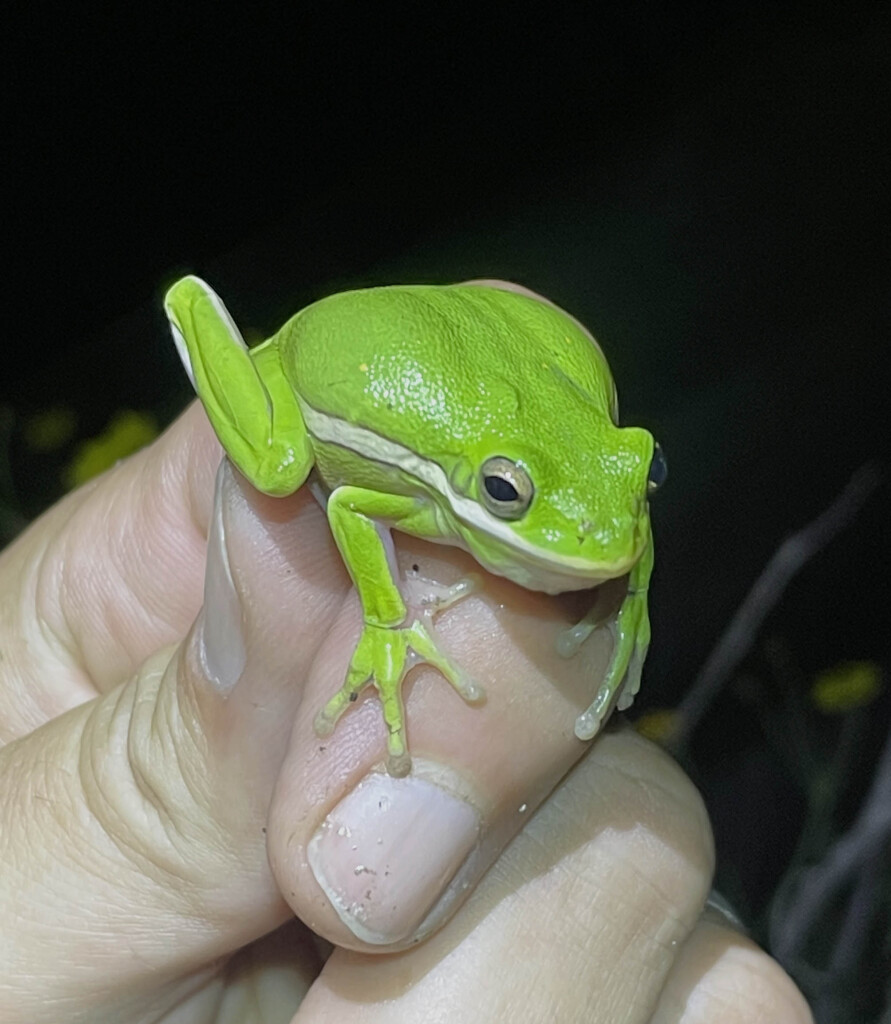
Green tree frog counted during Natural Bridge Caverns biological survey.
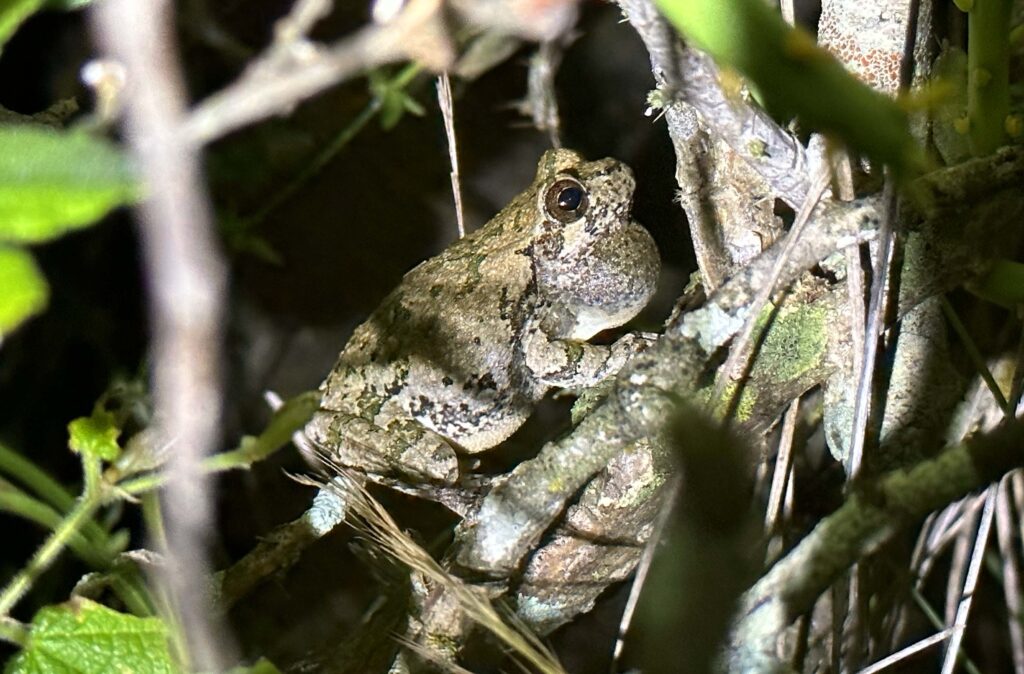
Cope’s grey tree frog calls out for a mate during the frog hunt at Natural Bridge Caverns.
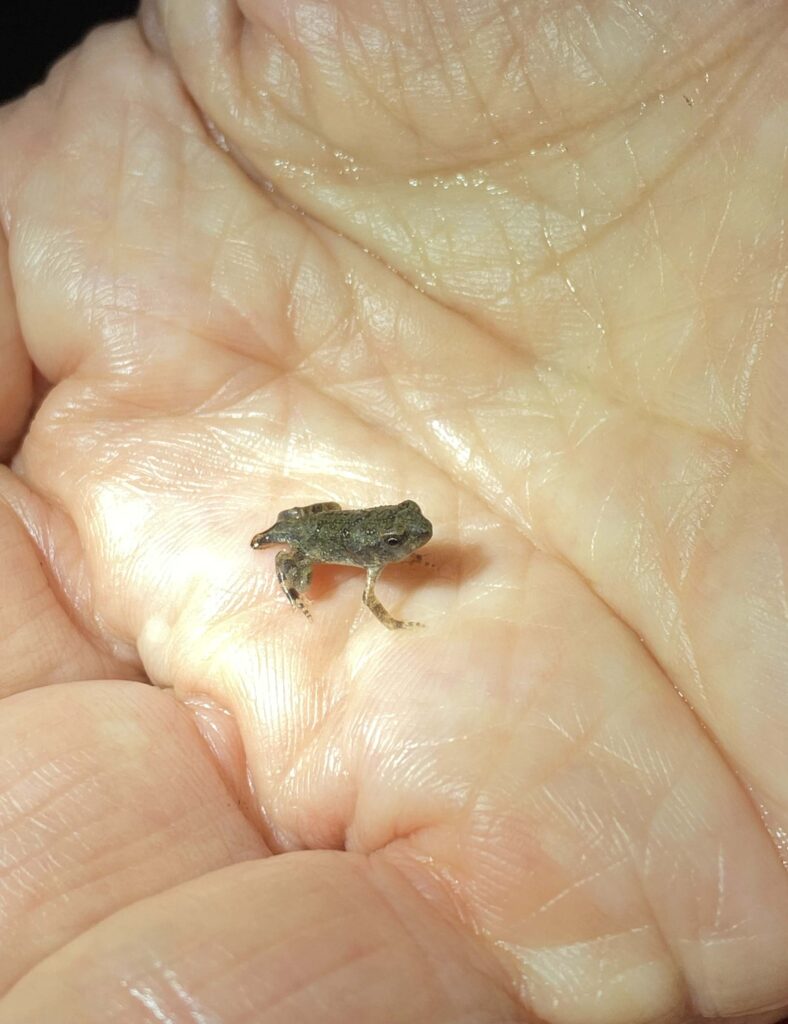
This baby Northern Cricket frog found a helping hand during one of the frog hunt survey expeditions at Natural Bridge Caverns.
Natural Bridge Caverns biological survey above ground hunted for frogs in an effort to better understand and care for habitats surrounding the cavern system.
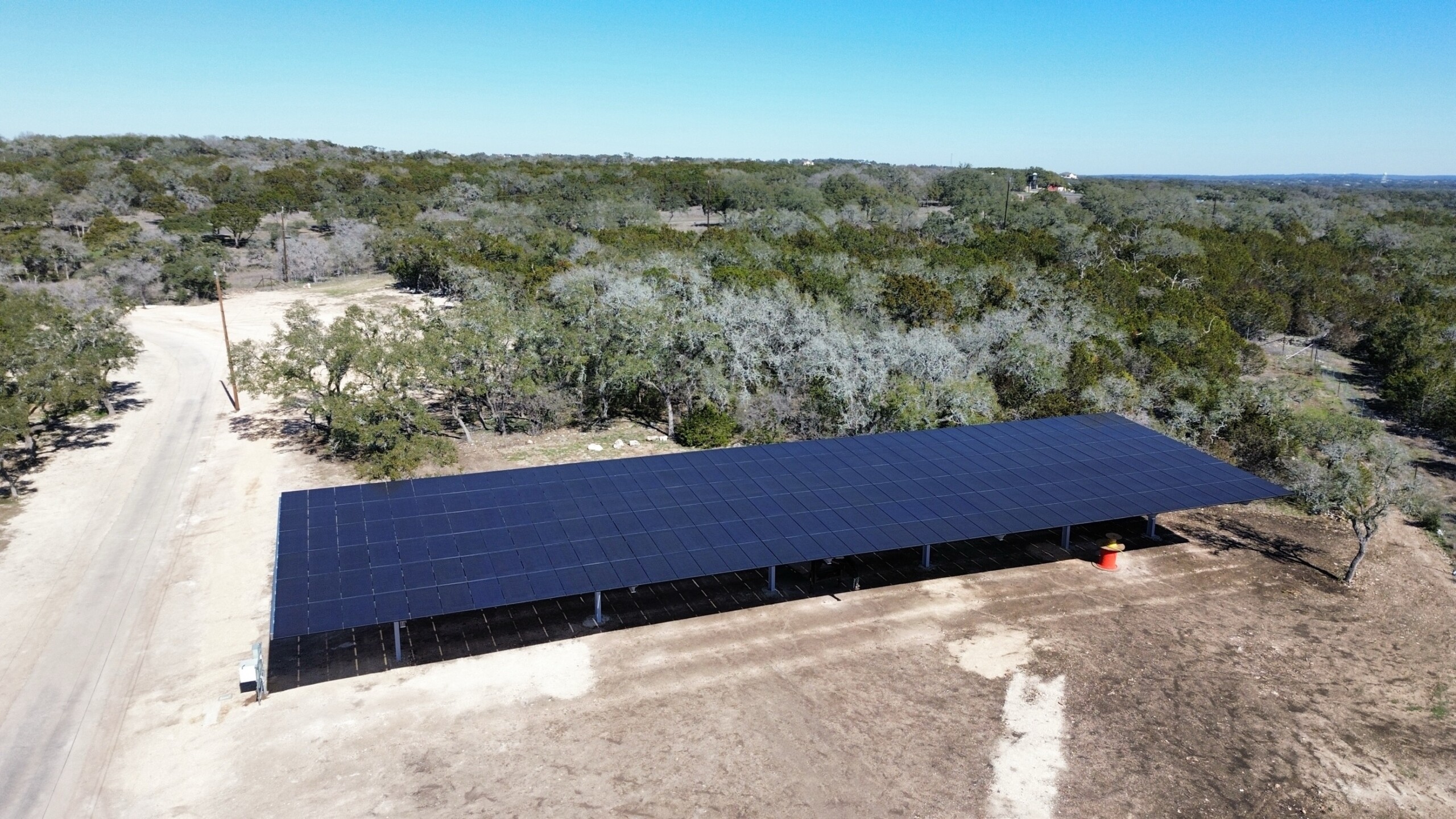
Natural Bridge Caverns (the Caverns) is now powered by the one resource never seen underground – the sun! In Phase One of a multiphase project, the Caverns has installed their first 108-kilowatt Mission Solar Modules with a potential annual solar production of 155,321 kWh. This green energy production replaces the burning of 123,299 pounds of coal, reducing our carbon footprint by 110 metric tons. The installation will offset 80% of the power needed for the entire Discovery Village above ground complex – the equivalent of 15 homes. Mission Solar Modules are engineered and built in San Antonio. Big Sun Solar worked with the team on the design and installation of the solar array which also serves double duty as a solar canopy. (video here)
To our knowledge Natural Bridge Caverns is the first show cave in the Texas to adopt solar power for its above ground operations. The Caverns also employs robust backup systems from Caterpillar to ensure complete power generation capabilities year-round. These systems operate even when the power grid goes down so guests will not be in the dark while enjoying the spectacular beauty of the cavern.
The solar install itself was not without its challenges. The in-house team had to trench 620 feet through solid rock to connect to CPS Energy service from the array. Location of the array and trenching was carefully chosen to avoid impact on the cavern below ground.
Future phases of solar projects are in the planning phases now.
The PESH Expedition survey of Sistema Huautla added length to the alreadyrecord-breaking cave as well as preparing for more explorations in 2024.
Huautla de Jimenez, Oaxaca, Mexico (June 6, 2023) – Cave explorers from around the world hit a milestone during their exploration and survey of the deepest cave in the Western Hemisphere, Sistema Huautla, this Spring. The international team of 37 cavers and support staff added 222 meters to the known length of the cave system during the most recent Proyecto Espeleologico Sistema Huautla, or PESH expedition. The known length of Sistema Huautla is now just over 100 kilometers or 62.27 miles. Teams also added three kilometers to the Cueva Elysium, a nearby but currently unconnected cave system. The accomplishments were announced as part of the celebration of International Cave Week, June 4-10.
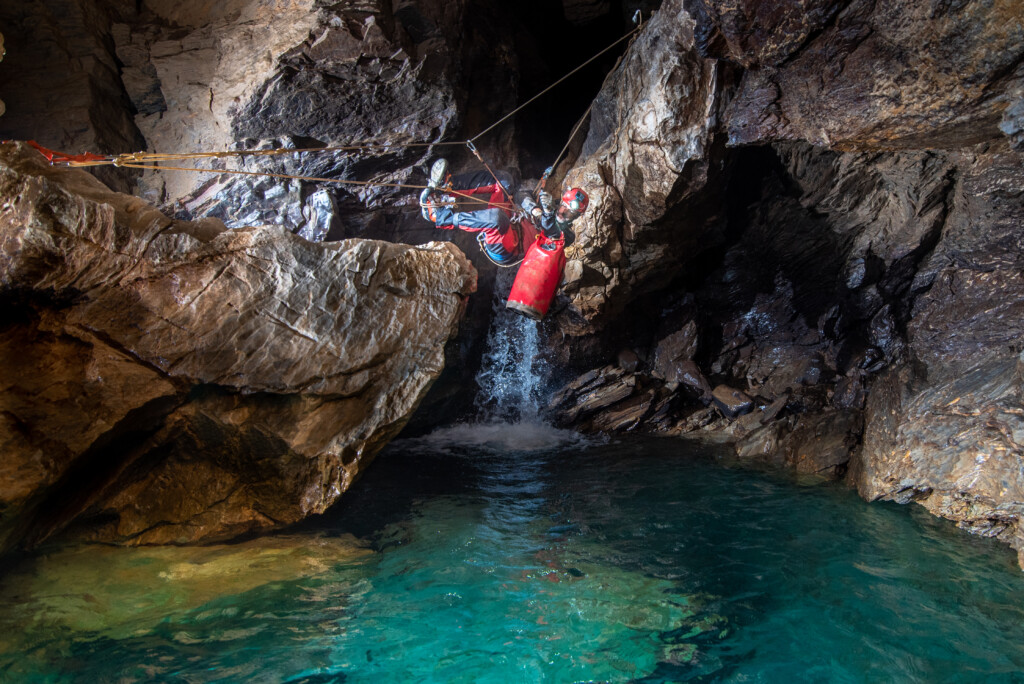
Brad Wuest makes his way over water on a taut line and slack line rigging in Sistema Huautla – photo credit Chris Higgins
In addition to continued exploration and surveying, the April 2023 PESH Expedition had several objectives including rigging 2,000 feet of rope in two other nearby caves. Both caves are far deeper than any cave in the United States. The rigging in these caves were left in place (although the ropes were pulled to prevent damage from seasonally rising waters) for next year’s expedition. The 2024 expedition will focus on these other two caves for exploration and surveying, which will enable the team to add these caves to the overall cavern system.
Discovered by Texas cavers in the 1960s, the caves in Huautla de Jimenex, Oaxaca, Mexico, have been the center of annual expeditions starting in 2014. PESH co-leaders and renowned cavers, Tommy Shifflett from Virginia and Bill Steele from Texas, have planned the April expeditions from the start.
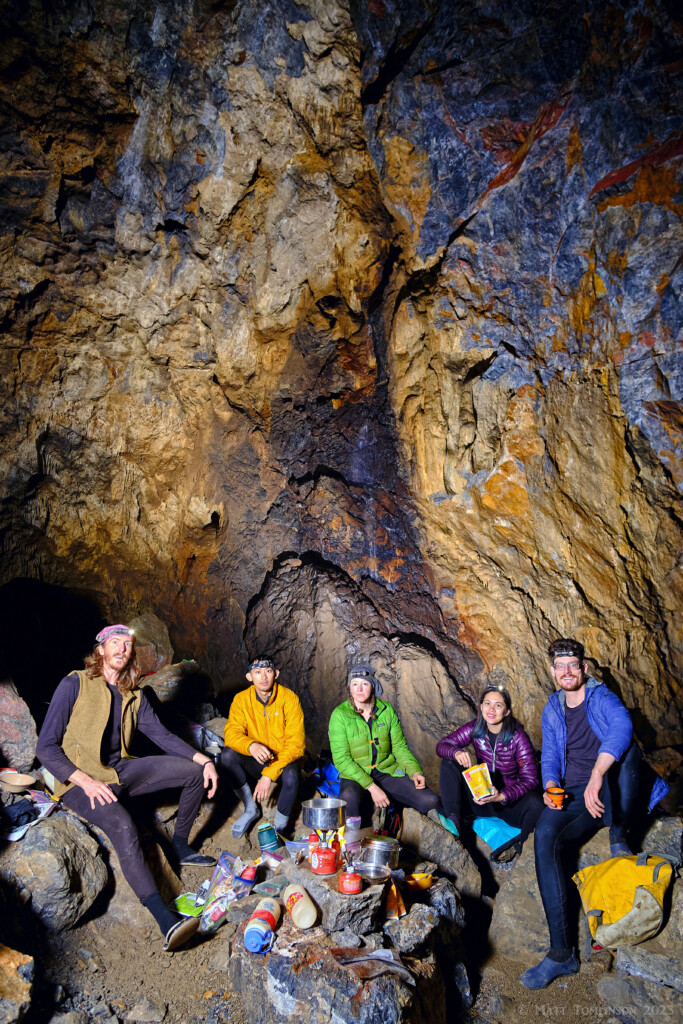
PESH 2023 Matt Tomlinson – Multi-day stay at Camp Berta in Elysium Cave
“We plan the expeditions in April because it’s the driest month of the year in the mountains,” said Steele. “With teams camping deep underground with no way to contact the surface, we are always keeping an eye on water levels. This April it was wetter than normal; that hampered our exploration somewhat.”
PESH 2023 Jessica Pruitt – Tommy Shifflett descends into Elysium Cave
PESH expeditions are made possible by sponsorships of various organizations, and this year the foundation of the largest cavern in Texas, Natural Bridge Caverns, joined the effort. Natural Bridge Caverns is considered Texas’ most actively explored cavern system, an effort Steele has participated in with co-owners Brad and Travis Wuest.
“We were pleased to both support PESH and to journey to Huautla ourselves,” said Brad Wuest. “Discovery is at the heart of our work here at Natural Bridge Caverns and we appreciate the efforts of cavers around the world to further explore and understand these incredible natural wonders.”
The current surveyed depth of Sistema Huautla is 5,118 feet, equivalent to four Empire State buildings. Cave geologists estimate the vast natural underground labyrinth is as old as 15 million years. All data collected is shared with Mexican cave scientists including information on cave adapted lifeforms, paleontological remains of extinct animals (which are photographed but left in the cave), and ancient climate patterns through analysis of stalagmites. The 2023 expedition also achieved another significant milestone – it carried the flag of The Explorers Club, an award granted to the top expeditions in the world. With the system now over 100 kilometers, excitement for further exploration continues to grow.
“We are grateful to the people of Huautla and the international community of cavers who continue to encourage us to keep exploring,” said Steele. “It’s one of the most magnificent caves in the world and it’s a privilege to uncover more of its beauty and wonders.”
About PESH: PESH Expedition is a 501(c)3 non-profit created to support the exploration, survey, and comprehensive speoleological study of the Sistema Huautla area caves. Annual expeditions have been underway since 2014, and the results of each expedition supports the ongoing underground research of Mexican scientists. For more information about the PESH Expedition as well as updates on plans for 2024, visit http://www.peshcaving.org/
About the Natural Bridge Caverns Heidemann – Wuest Foundation: Established by Natural Bridge Caverns founder Clara Wuest Heidemann in 1997, Heidemann – Wuest Foundation (HWF) supports not-for-profit charities that focus on youth and agriculture, education, heritage, faith, wildlife, conservation, exploration, law enforcement, and veterans. Each year the HWF contributes more than $100,000 to charitable organizations in the San Antonio and New Braunfels area. For more information on the philanthropic work of both the HWF and Natural Bridge Caverns, visit https://naturalbridgenews.com/about-us/.
The Back Story of Discovery of Wildcats in Natural Bridge Caverns
Overview
The University of Texas Jackson School of Geosciences and Natural Bridge Caverns and are launching a joint expedition in January to solve an ancient mystery: what kind wild cats left tracks/paw prints one mile from the entrance inside Natural Bridge Caverns – and are they the same wild cats whose bones lie at the base of a sheer drop in the cave?
The expedition to recover the bones, examine the trackways, and begin the process of study will be led by John A. Moretti from the Jackson School and Brad Wuest, president of Natural Bridge Caverns. It will involve complex ascending and descending rope work and crawling through tight muddy passages to get to the three sites where the bones have been undisturbed. The team will then carefully extract the bones and encase them to ensure they survive the trip back through the Cavern.
New Wild Cats Found In June of 2021, Wuest led an expedition to rig access pits and re-survey a large chamber and passage complex called the “Dungeon”. On that expedition the team found fossilized bones embedded in calcite formation. The team knew a wild cat skeleton had been discovered in the past on the Dungeon floor eighty feet below a series of pits however, the newly found bones were in a different location at the top of a slope of rubble and flowstone. Wuest contacted paleontologists with the Jackson School to learn more about the bones previously collected in Natural Bridge Caverns during the early 1960’s, to see if photos of the newly found bones could be identified and coordinate plans for their retrieval.
Finding Tracks
Following that outreach to the Jackson School, a highly unusual set of cat tracks were discovered in March of 2022 during a biological survey of the cavern, some tracks only ten feet from the mouth of the pit about eighty feet above the wild cat bones originally found on the Dungeon floor. The tracks are a full mile from the only known natural entrance into the cavern through completely dark and muddy passage, giant chambers, and many potential pitfalls and ½ mile from the closest commercial trail in Discovery Cavern. Within one week of discovering the cat tracks even more wild cat bones were discovered at the bottom of a sixty-foot-deep pit in a huge chamber called the Inferno Room. Tracks were also found not far from the top of this pit. Later yet, a third wild cat partial skeleton was found in a completely different area of the cave, closer to the entrance. The partial skeleton is nearly complete, a rare occurrence in specimens of small cats in the fossil record, and includes a partial skull, upper dentition, left and right dentaries, and all major limb elements.
History: Bones from 1960s
These are not the first set of wild cat bones discovered at Natural Bridge Caverns. The first were extracted in 1963 by early cave explorers, and initially identified by the University at Texas as a bob cat. However further research on wild cats has indicated that it’s possible that the bones are likely to be from an extinct form of a river cat, or potentially, a jaguarundi (which is now considered extinct in Texas). The 1963 recovered bones are part of the Jackson School’s collection; these new bones will be as well.
A new expedition is set for August 6th in Natural Bridge Caverns, and this time the effort is focused on developing a better understanding of this unique environment. A biological inventory, conducted by Texas based Zara Environmental, began earlier in 2022 so far has produced a picture of a thriving ecosystem in the cave and discovered six new species not found in the caverns previously. The search is now on to find more in a newly discovered hidden stream of water deep below the surface and follow it to where no person has ever been.
Among the thriving cave adapted species the researchers have found so far are non-endangered top predators including Chinquipellobunus madlae, an orange cave-adapted harvestman, as well as tiny snails that live in the groundwater deep within the cave and are the size of sand grains. [Video and photos here]
The six new species recorded for the cavern and a few species collected required taxonomic work under the microscope to identify. Two of the new species to Natural Bridge Caverns were groundwater crustaceans; a Cirolanid isopod and an amphipod (Stygobromus russelli) that looks like a small shrimp without eyes and pigment. Hundreds of snails were collected and sent to Dr. Kathryn Perez at U.T. Rio Grande Valley, an expert in aquatic snails. Dr Perez identified a groundwater snail, Phreatodrobia plana, collected amongst mostly freshwater snails, Phreatodrobia nugax. The team at Natural Bridge Caverns plans to showcase these new species, as well as others previously found in the cavern system, in a new educational exhibit scheduled to open in 2023.
“Our guests are fascinated by the adaptations necessary for animals of all types to live in a cave,” said Brad Wuest, president of Natural Bridge Caverns. “As stewards of this cavern system we know the more we understand about the species that inhabit the cave, the better we’re able to track our efforts in safeguarding the environment all around it. A biological sampling is one step in that effort. As cave explorers we’re also fascinated by life in these beautiful, dark places.”
In the world of cavern dwelling species, the cave adapted Chinquepellobunus in Natural Bridge Caverns is the equivalent of a grizzly among the tiny creatures of the cave world. It looks to us like a thin-legged spider with a body smaller than the end of a Q-tip, but when scientists look closely, they can see arm-like mandibles that have a row of long spiny teeth. Chinquepellobunus is not a spider at all – it is a different group of arachnids altogether. This is one of the cave-adapted species guests could be lucky enough to see during a public tour of the caverns. The Cicurina varians and Araneae are two types of spiders found in the cavern along with a common cave insect, the Texoreddellia, which is a subterranean silverfish. In the water within the cave the team found two types of springtails: Collembola and Symphypleona. Biologists also snapped a photo of an eyeless amphipod that is yet to be identified.
“It’s important to understand the biodiversity of the cave system because a healthy cave means healthy groundwater,” noted Liza Colucci, project manager and ecologist from Zara Environmental. On August 6th, the team plans on pushing into newly discovered areas to determine if identical species to those found in earlier expeditions exist there as well and also to see if additional aquatic species exist in the new areas. The team is also considering conducting a dye trace to confirm the water flow throughout the cave. Surveys indicate that the newly discovered Popcorn Pit River is upstream of the River Styx and other locations, but a dye trace will prove it definitively.
For more information about adventure caving tours, walkable public tours, and above ground adventures at Natural Bridge Caverns, visit NaturalBridgeCaverns.com.
Natural Bridge Caverns is one of the world’s premier show caverns. Discovered in 1960 by local cavers, this family owned and operated natural wonder is the largest cavern in Texas. In addition to multiple tour experiences through two distinct caverns, the property features above-ground adventures of a different kind including a ropes course, zip rails, a 5,000 square foot outdoor maze, and even an interactive “gem panning” activity. More of the cavern system itself is still being discovered; the Wuest family along with their caving team are still actively exploring new areas in the massive cavern. Natural Bridge Caverns is a designated State Historical Site, National Natural Landmark, and is listed on the National Register of Historic Places.
Natural Bridge Caverns to Share Recent Discoveries and Host Cave Demonstrations During International Day of Caves and Subterranean World Celebration on June 4-5
The Natural Bridge Caverns expedition team returned after a 16 and half hour trip attempting to make a connection between Natural Bridge Caverns’ Hope’s Mantel to the south and the Wild Cave to the north. Photos from the expedition will be shared at International Cave Day events at the Cavern on June 4th and 5th. It’s how Natural Bridge Caverns’ will join cave enthusiasts from around the world to celebrate the International Day of Caves and the Subterranean World (aka International Cave Day) on June 6th. The goal is to inspire greater appreciation and stewardship of cave and karst landscapes.
“After about seven hours of hard caving we arrived at Hope’s Mantel excited to discover what lay below. After rigging the pit, we descended and surveyed a beautiful room, however the passage beyond that point was filled with flowstone formations and breakdown rubble,” said Brad Wuest, one of the expedition leaders and president of Natural Bridge Caverns. “We pushed every lead in the area but couldn’t make it through, although we could feel airflow indicating a small connection somewhere through all that breakdown. In all we were able to close the gap by 50 feet this time, so now the two caves are only 250 feet apart.”
The expedition teams are not giving up on finding a connection but are shifting focus to continued exploration of other areas of both the Wild Cave to the north and promising unexplored sections of Natural Bridge Caverns in an area around the room called The Dungeon. Every exploration has the potential to add to the known size of both caverns. Expeditions are in the planning stages, with the first scheduled for later this month.
Natural Bridge Caverns is unusual in comparison to other unexplored caves in Texas in that expedition teams have repeatedly discovered previously unknown massive chambers throughout the system. So, the potential to find additional “big cave” is strong. Several leads (leads are pits, crawlways, and passages that may be hidden or hard to get to and have not been explored yet) have been identified and are there, waiting for expedition teams to explore. The Wild Cave also continues north, and during the last expedition there the team had to limit the final part of their exploration that day to an upper passage – the lower passage was filled with water. Then Wild Cave exploration was stopped only by the clock – they had reached their “turnaround time,” a hard and fast rule followed by explorers to ensure safe returns during exploration. It’s possible, if the water in that area has receded, that there are additional lower-level leads there that are worthy of pursuit on future expeditions this year.
It’s both the unknown and incredible finds of the last two years that drives the desire for exploration for the Natural Bridge Caverns expedition team. More people have walked on the moon than have seen some of the remote areas known in Natural Bridge Caverns, not to mention the areas being discovered that no one has ever seen. “Caves are not always ready to reveal their wonders,” noted Brad. “But that doesn’t stop us from gearing up for more exploration to search for these hidden wonders.”
Travis Wuest, Natural Bridge Caverns vice president and expedition member, agreed. “We’ll never stop exploring, especially given there is still so much to learn and discover. Just in the last two years we’ve found large chambers filled with breathtaking speleothems, crystal clear travertine pools of water, pits that go down to the aquifer, and beauty never before seen by anyone in the world. We know there are more big discoveries waiting beneath our feet.”
For the team, it’s not just about finding unknown areas of the cavern system. Understanding the cavern, its history, and its eco-system are equally important. Archaeologists just finished a dig in the area, examining burn rock middens. Bio-diversity expeditions have begun an extensive study of the cave adapted species that call this subterranean world home. A future trip is planned to recover fossilized wild cat bones from the cave with the help of a paleontologist. The Wuest family just received the Lone Star Land Steward Award from Texas Parks and Wildlife for their efforts to preserve, restore, and protect the habitat all around Natural Bridge Caverns, all in an effort to be strong stewards for both the land and the Cavern.
Saturday and Sunday the public will have a chance to see the results of the latest exploration as well as take part in cave crawls and learn about rope techniques used in caving. Natural Bridge Caverns will also launch an Explorers blog this summer, giving fans an inside view of the efforts by our team to better understand this incredible natural wonder, sharing videos and photos of trips, and providing education on biodiversity, paleontology, and so much more. To stay up to date, visit the Natural Bridge Caverns website or connect on the Caverns social channels.
Natural Bridge Caverns is one of the world’s premier show caverns. Discovered in 1960 by local cavers, this family owned and operated natural wonder is the largest cavern in Texas. In addition to multiple tour experiences through the caverns, the property features above-ground adventures of a different kind including a ropes course, zip rails, a 5,000 square foot outdoor maze, and even an interactive “gem panning” activity. More of the cavern system itself is still being discovered; the Wuest family along with their caving team are still actively exploring new areas in the massive cavern. Natural Bridge Caverns is a designated State Historical Site, National Natural Landmark, and is listed on the National Register of Historic Places.
Currently the most active cave exploration effort in the state, recent discovery of a new cave could increase the length of the cavern system substantially.
A highly specialized caving team is embarking on a journey through unexplored cave passage at Natural Bridge Caverns in an attempt to find a connection between a newly discovered cave and the northern reaches of Natural Bridge Caverns. Led by brothers Brad and Travis Wuest, owners and operators of Natural Bridge Caverns, the next expedition is an epic push to try to discover connecting cave passage. The expedition is set for Friday, May 27th, 2022, and could take 24 hours to complete.
New Cave DISCOVERED – Wild Cave
The new cave was first hinted at in 2019 when steam was spotted rising from a narrow crack along a dry rocky creek bed surrounded by thick cedar. The warm air rising from the crack indicated the possibility of a large void somewhere below. The narrow crack proved to be the beginning of a deep pit that aligned with but was beyond the furthest reaches explored in Natural Bridge Caverns. In 2020, T. Dexter Soechting, great grandson of Natural Bridge Caverns founder Clara Wuest Heidemann, was the first explorer to enter the pit. At the bottom he found a small hole blowing air so forcefully it caused his shirt to flap. Early in January 2021, a team of Natural Bridge Caverns cavers descended what is now known as Simian’s Pit. After a day of hard digging the cavers were able to open the airway into a tight crawlway that led to the top of a giant room, Goliath’s Dome. “I was not old enough to remember my great-grandmother before her passing,” noted T. Dexter Soechting, the first explorer of Wild Cave. “So, to be part of the exploration team is not only exciting but a connection with my heritage.”
Natural Bridge Caverns’ cavers spearheaded exploration of the Wild Cave in 2021 with hopes for more than discovery of a new cave. In the southernmost reaches of the Wild Cave, a room called the House of Cards is within a tantalizing 300 feet from the end of Natural Bridge Caverns northern most surveyed location, Hope’s Mantel.
Today the caving team is gearing up for an incredible expedition. The team is planning to push through from the Natural Bridge Caverns side in one of the longest expeditions yet. If the team does find a connection from Natural Bridge Caverns’ Hope’s Mantel area to the Wild Cave’s House of Cards room, the Natural Bridge Caverns system could add another 1,398 feet, bringing the total to 20,475 feet or 3.88 miles. This would make Natural Bridge Caverns the 6th longest cave in the state.
Exploration Restarted in 2019
A new era of exploration began in 2019 resulting in major discoveries of new, unexplored chambers. By February 2020 the caving teams had ventured to the northern most surveyed location of the cavern at Hope’s Mantel, a ledge overlooking a four-story tall room filled with beautiful formations and cavern passage extending beyond and out of sight. Unfortunately, at the time the team had no more rope to continue exploration. It had been a grueling effort to get to this area of the cave (some trips took 23 hours). Up to that point all combined they’d added 1.13 miles of cave passage to Natural Bridge Caverns. Then exploration paused in March 2020 when COVID required the team to focus their energies on navigating the pandemic for their families, business, and employees instead of exploration (a release covering exploration along with photos of exploration prior to 2020 is here. Animated map showing timeline of exploration is here).
Currently the explored and mapped area of Natural Bridge Caverns (without the Wild Cave) is 3.61 miles long, making it the 8th longest cave in the state, moving up from 13th on the list due to recent discoveries. Natural Bridge Caverns remains the largest cave (in terms of volume) in Texas and the cave with the most active exploration in the state.
“No other cave in Texas is being explored to the degree that’s happening at Natural Bridge Caverns,” said world renown cave explorer Bill Steele. “The discoveries have been nothing short of incredible.”
For more information about the expedition and future explorations, please refer to NaturalBridgeCaverns.com and social channels. Interviews with expedition leaders Brad Wuest and Travis Wuest are available upon request.
Natural Bridge Caverns is one of the world’s premier show caverns. Discovered in 1960 by local cavers, this family owned and operated natural wonder is the largest cavern in Texas. In addition to multiple tour experiences through the caverns, the property features above-ground adventures of a different kind including a ropes course, zip rails, a 5,000 square foot outdoor maze, and even an interactive “gem panning” activity. More of the cavern system itself is still being discovered; the Wuest family along with their caving team are still actively exploring new areas in the massive cavern. Natural Bridge Caverns is a designated State Historical Site, National Natural Landmark, and is listed on the National Register of Historic Places.