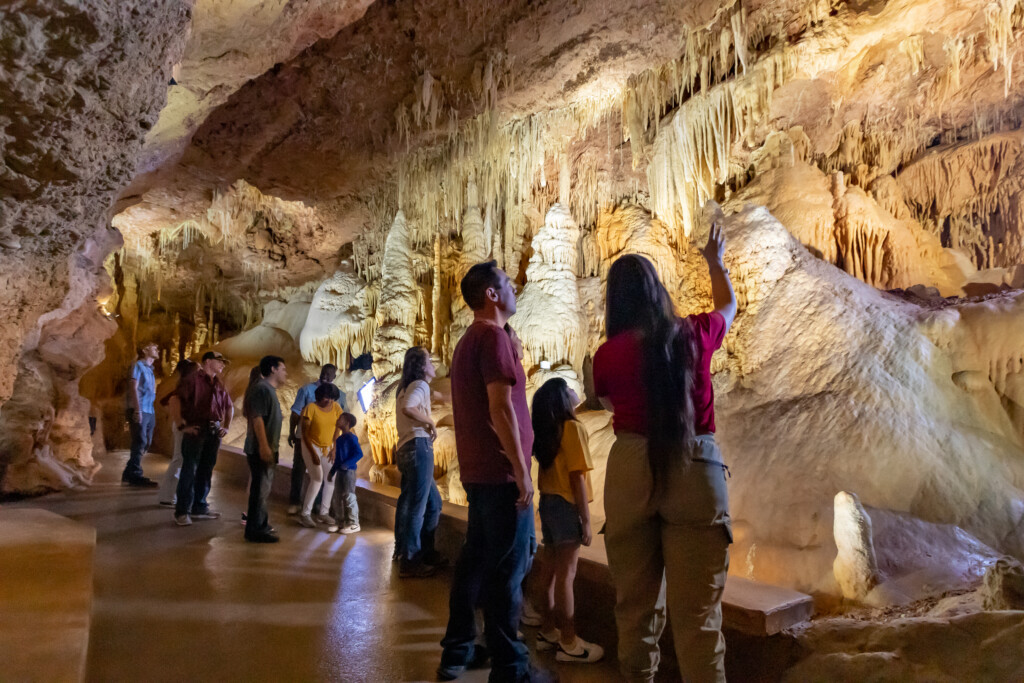
Taking stunning photos inside a cave is usually as easy as taking out your cell phone. Most modern cell phones have strong enough low-light settings which make it easy to catch the cave’s good side. It can be a little tougher to include yourself in the photo since our formations are carefully and artfully lit, and you standing in front of them are not. It’s a problem we usually solve by encouraging guests to use their flash or a second phone with a flashlight on to add your own spotlight.
The Cathedral Room’s colors are significantly more visibile thanks to the new lighting on the Hidden Wonders tour at Natural Bridge Caverns
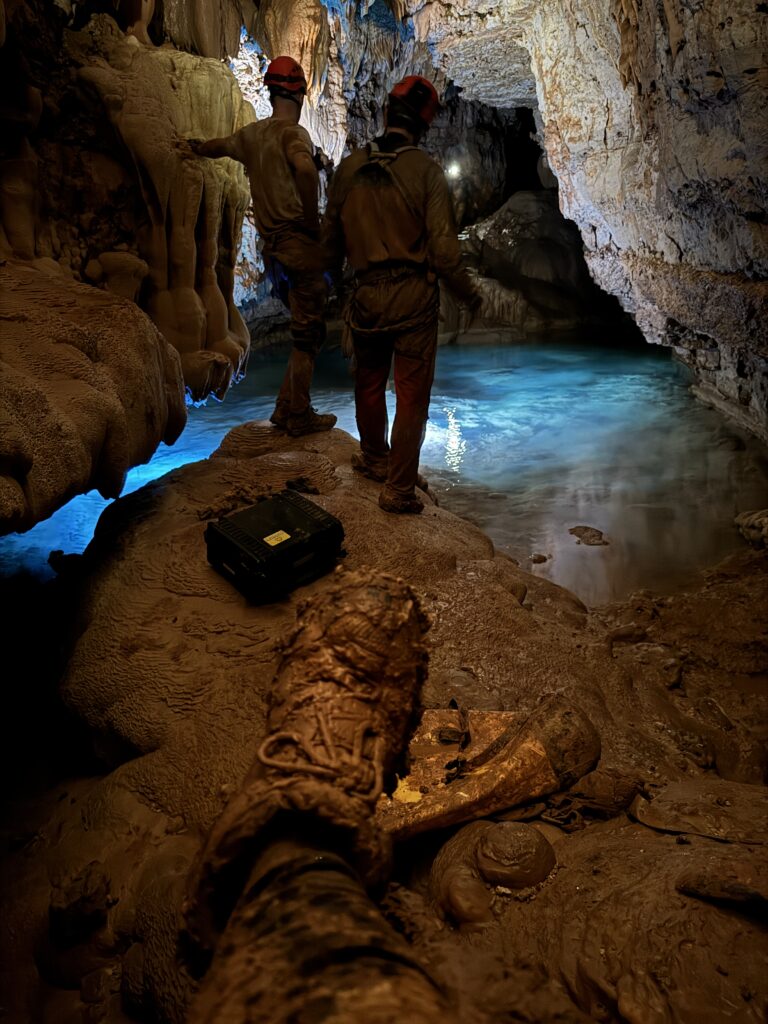
But when you go into the wild parts of the cavern system like our expedition team there are no multi-million dollar lighting systems showcasing the formations. Plus in our cave there is so much mud, it can be tough to get a clean shot (pun intended).
From a recent expedition to the Dome Pit. Note muddy boot in the foreground.
Fortunately we’ve worked with amazing professional cave photographers that have traveled the world capturing these incredible dark places and they’ve shared some tips and tricks for catching images deep in the dark underground.
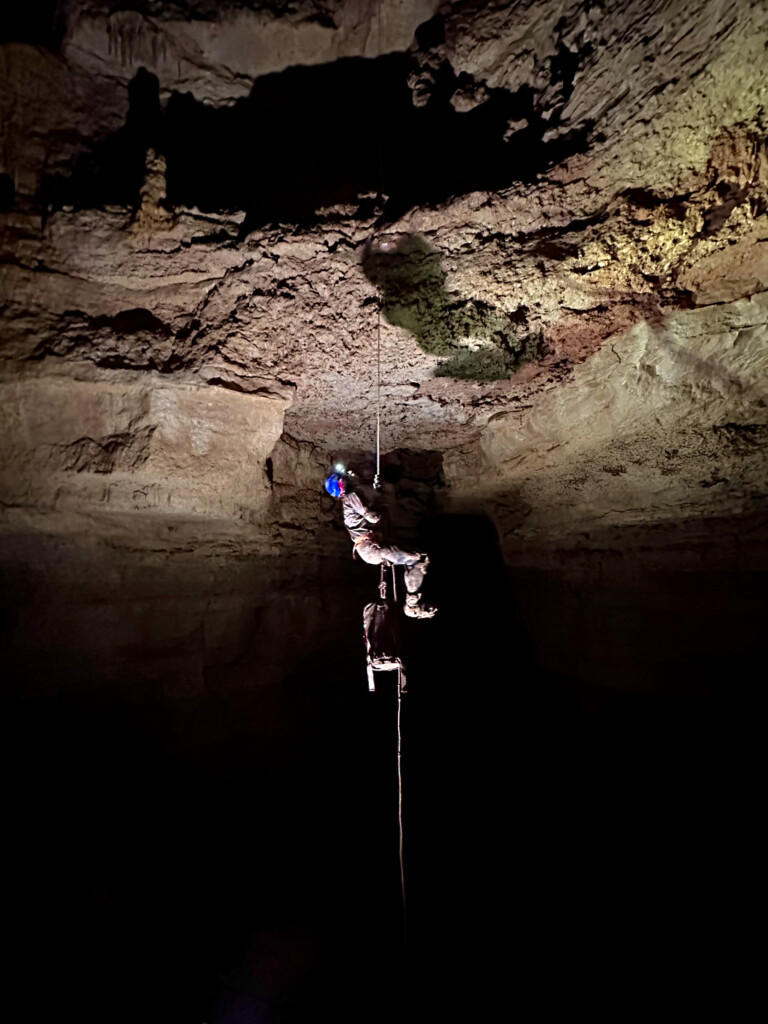
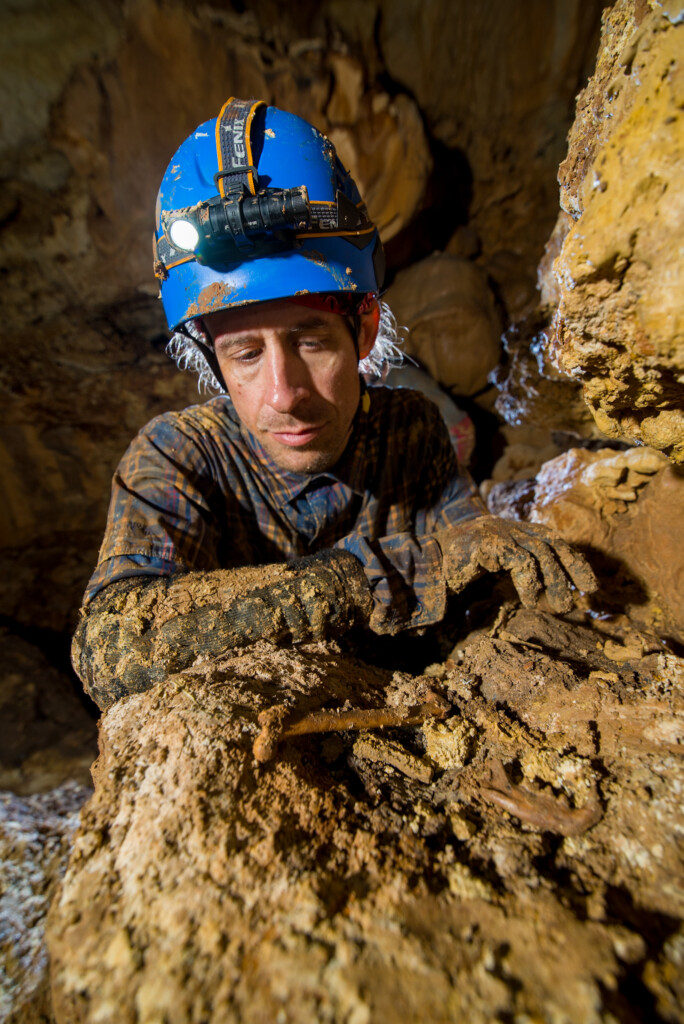
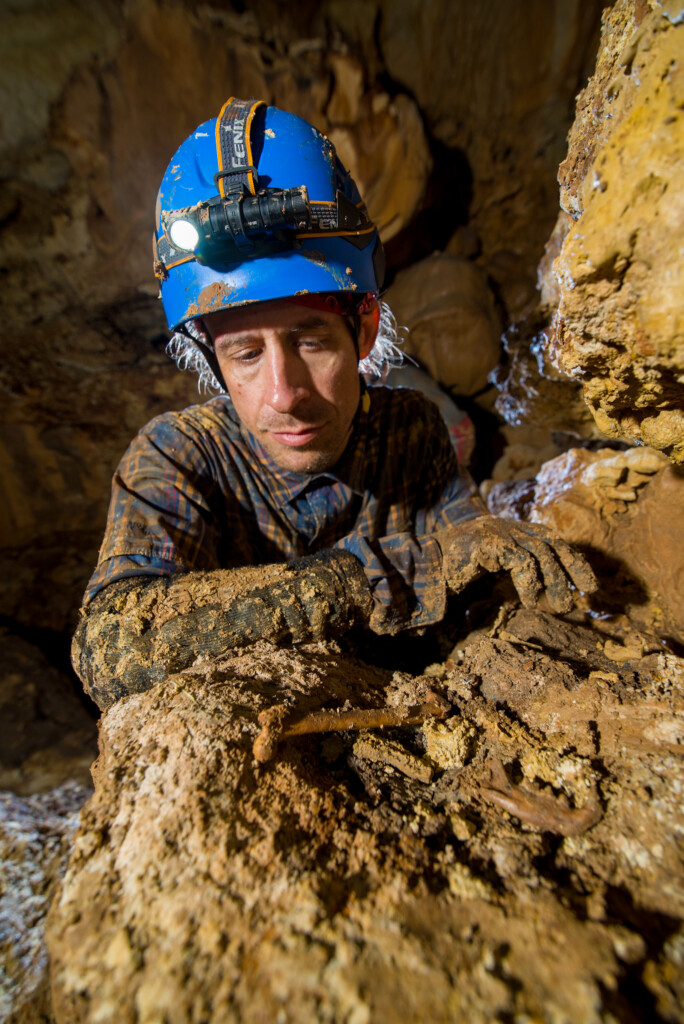
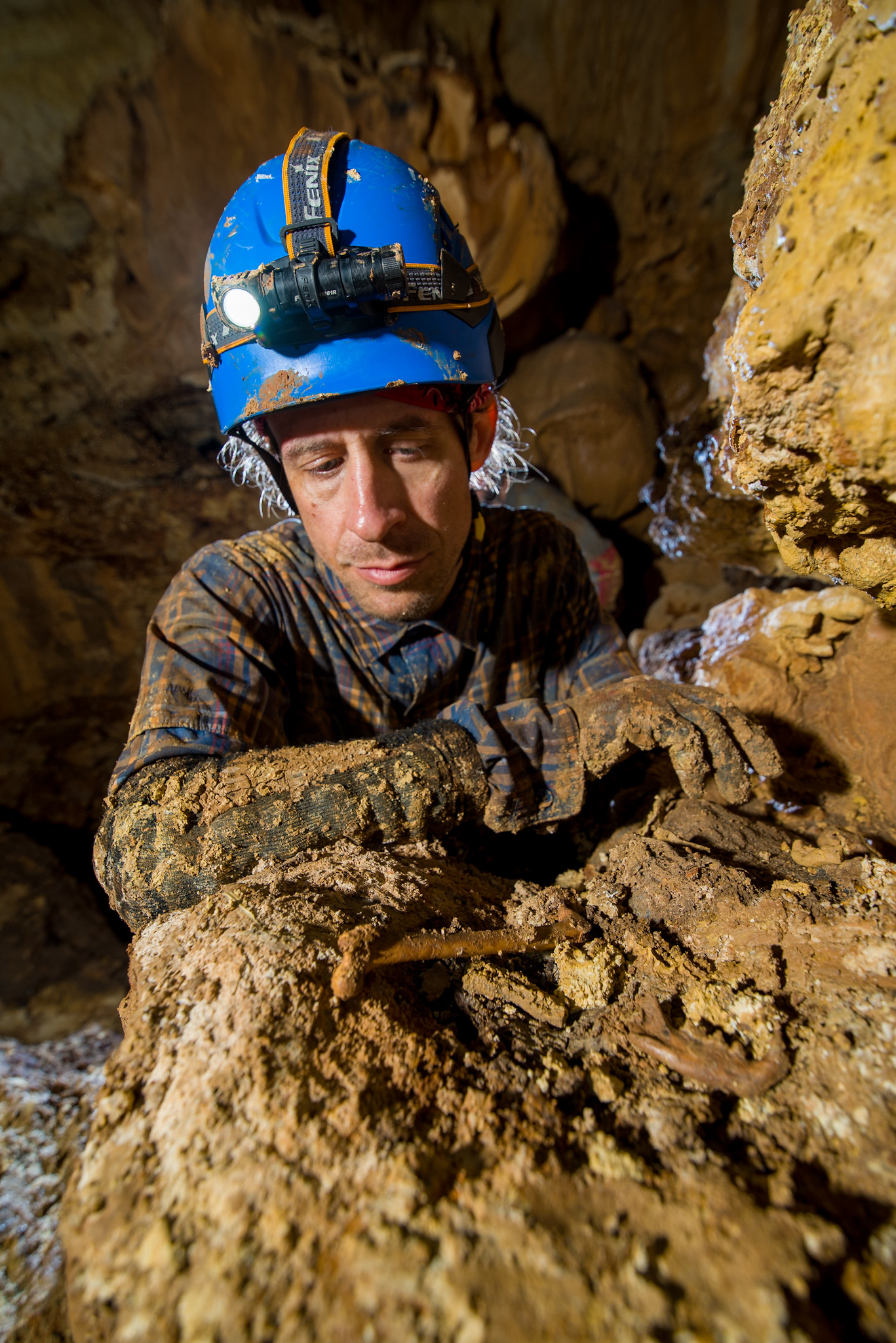
WildCat Expedition – Descending into the Cave to recover ancient wildcat bones. photo by Chris Higgins
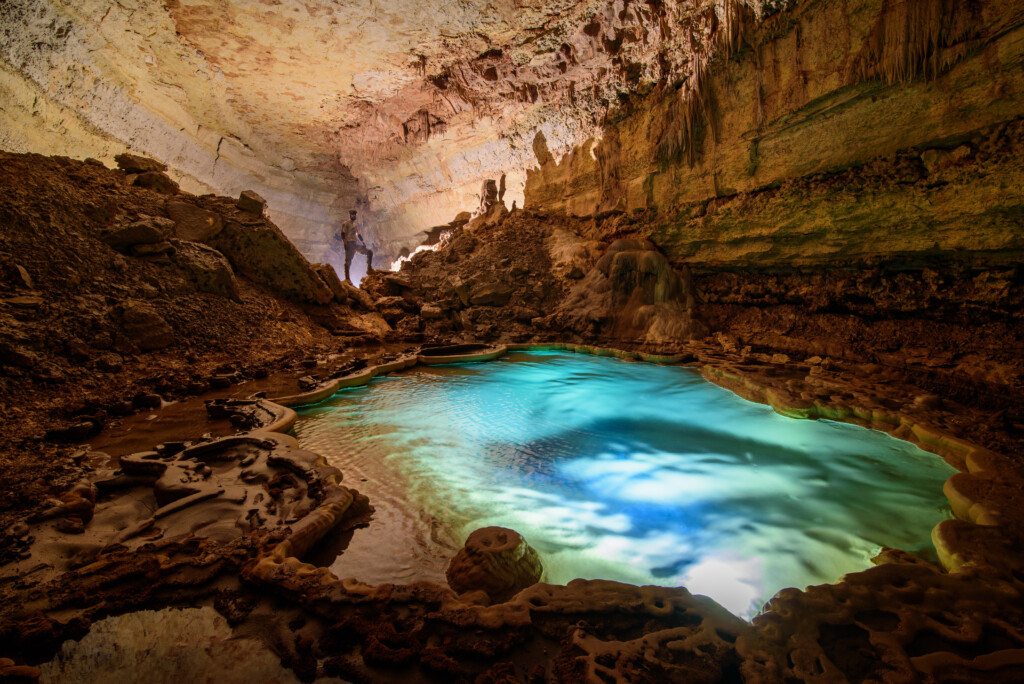
Stunning pool of blue water in the wild area of the cavern is in the foreground as a caver stands in the background. Photo by Chris Higgins
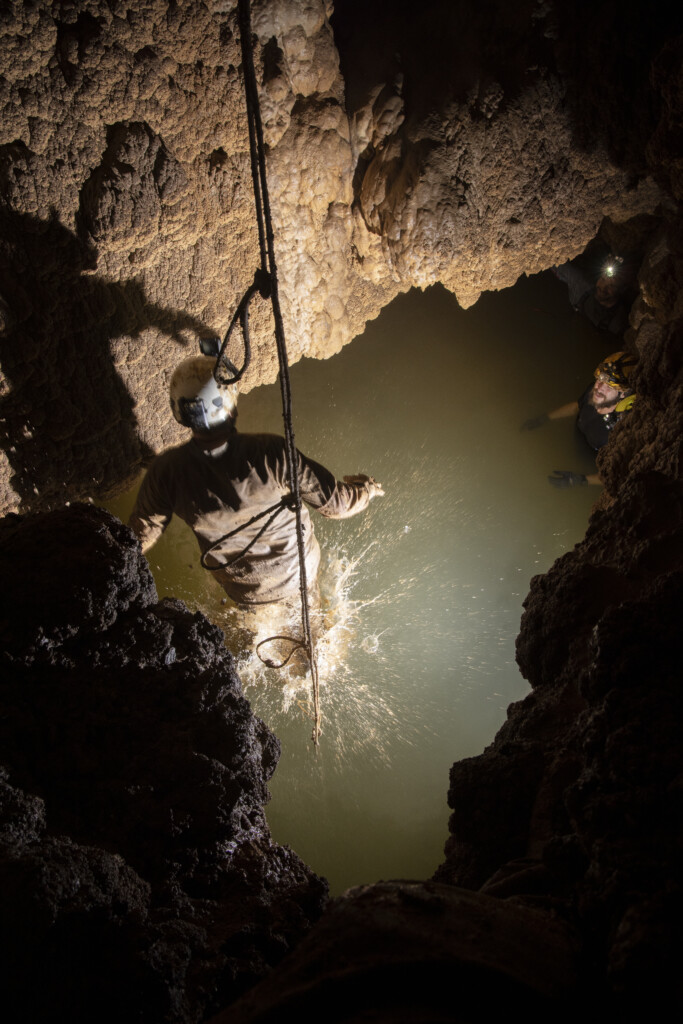
First you have to bring in lights. We carry in LED panel lights that are battery operated and capable of varying “warmths” which is rated on a Kelvin scale (fun article on that topic here). We also have smaller lights that can be placed under water which is critical to get a shot like the one above.
Travis Wuest jumps into the pool at the bottom of the northern passage.
Next you have to be an experienced caver to recognize cool moments that are there to be captured like this descent into a watery area. Having an artist’s eye for framing a shot helps too, with enough light to capture the splash, the dark cave and shadow drawing your eye to the action and another caver in the background for perspective.
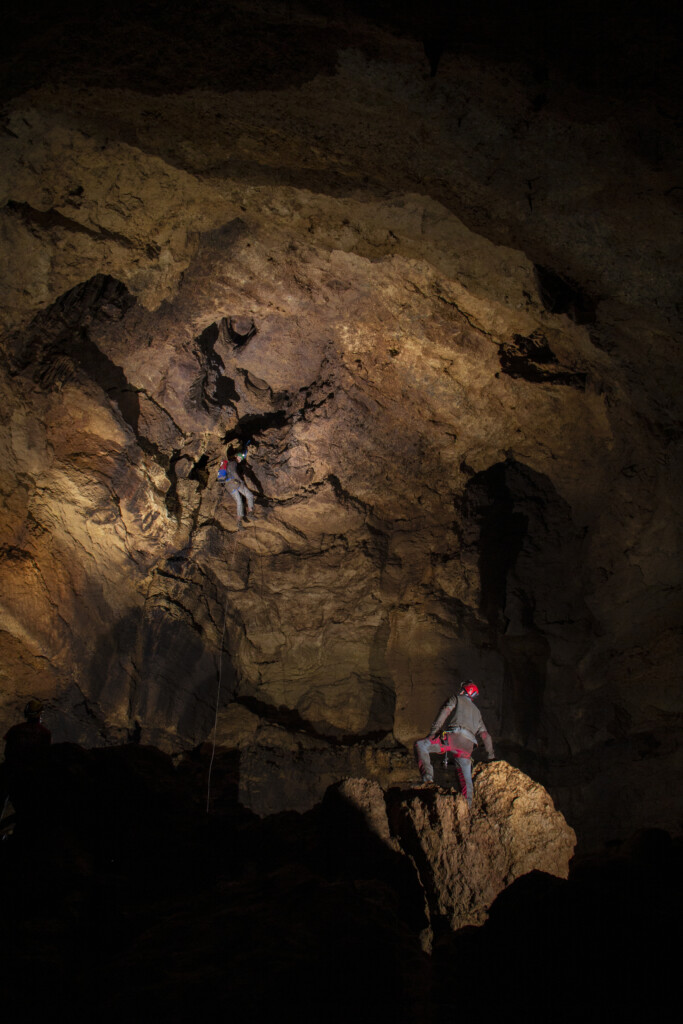
Brad Wuest watches as T. Dexter Soechting descends from the entrance squeeze into the room.
Next you need patience all the way around. Setting up lights takes time and getting everyone in the perfect position isn’t always easy. When you can “see” what isn’t quite there, you still have to paint (and repaint) the scene with light. Having a deep understanding of your camera’s capabilities is critical.
Skill, experience, a patient crew, and a beautiful cave. That’s all it takes! Curious about the wild areas of the cave? We do lead adventure tours through parts of it – learn more on our website.
Here’s a few more of our favorite shots from the wild areas in our cavern.
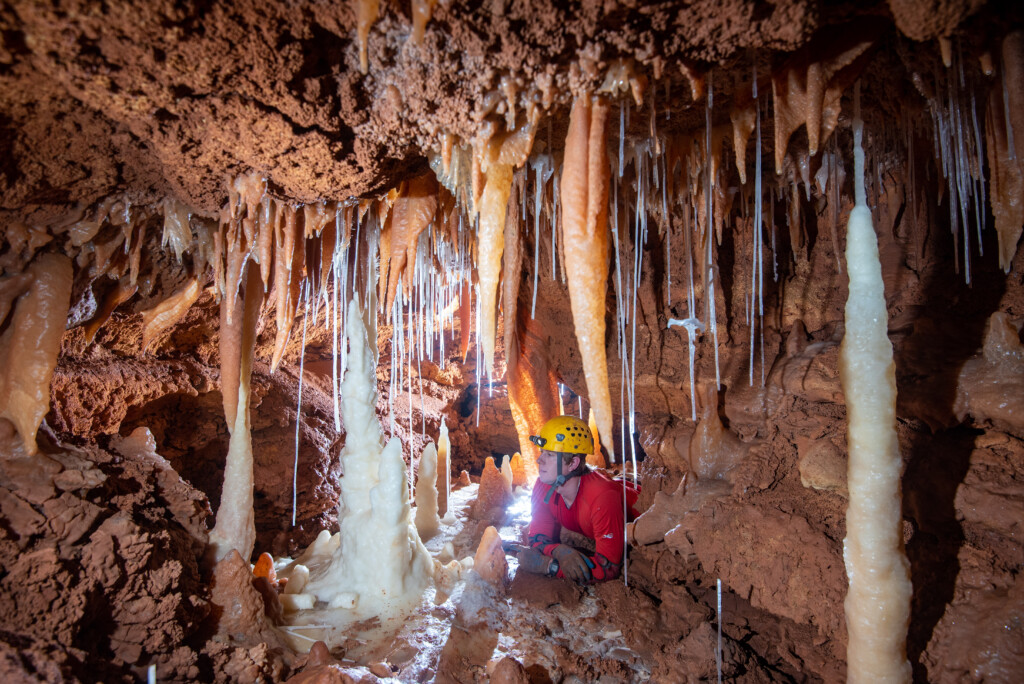
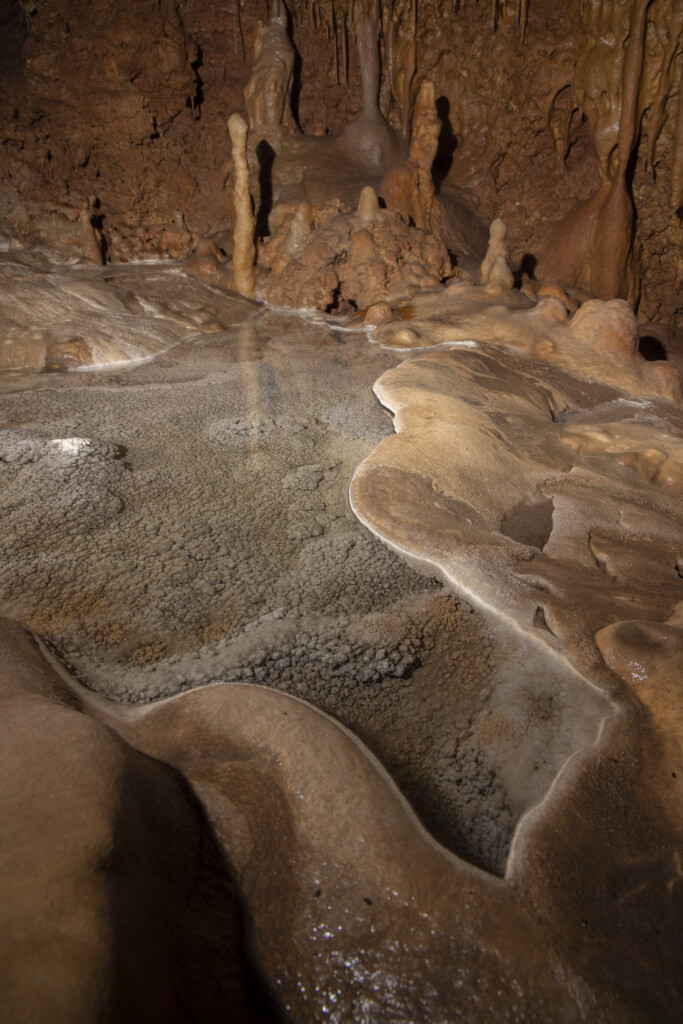
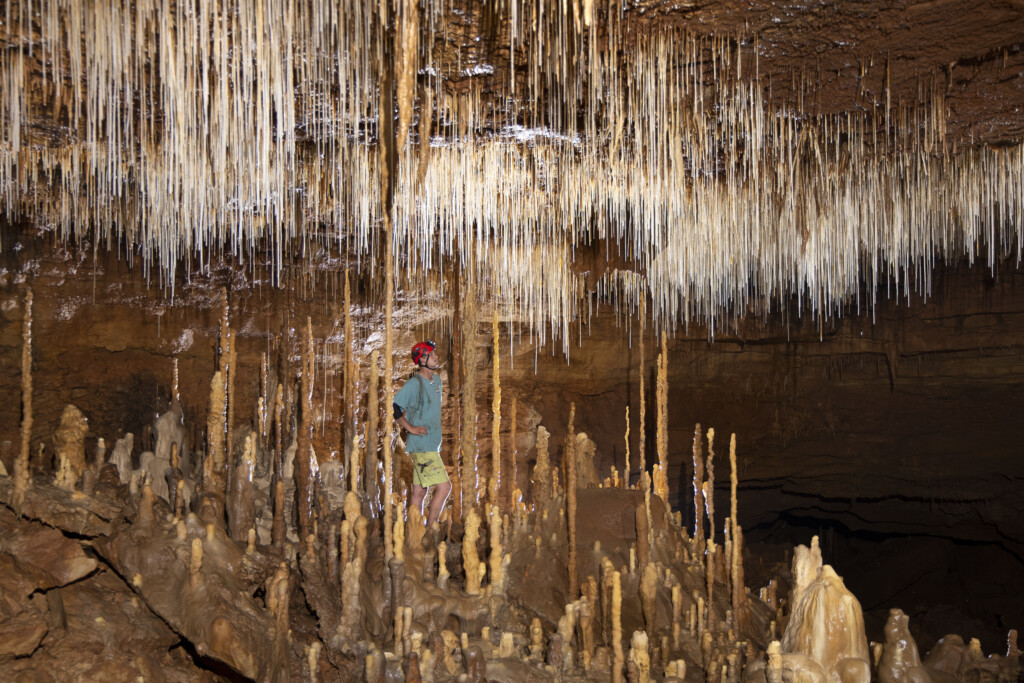
Searching for cave critters in the upper passage in a wild cave section of Natural Bridge CavernsFlowstone and pools at the end of the northern formation passage.T. Dex Soechting among the sodastraws and stalactites in the northern passage.J Morettie examining wildcat bones in Natural Bridge Caverns during Wildcat Expedition
Scientists Closing in on Answers About ‘Lost’ Prehistoric Cats of Natural Bridge Caverns – an update from the University of Texas at Austin
Last January, a team of cavers along with a paleontologist from The University of Texas at Austin rappelled into two deep chambers at Natural Bridge Caverns to retrieve rare fossil finds: the bones of two small prehistoric cats, each about the size of a house cat.
A year later, the bones of the Natural Bridge Cats are beginning to reveal their secrets.
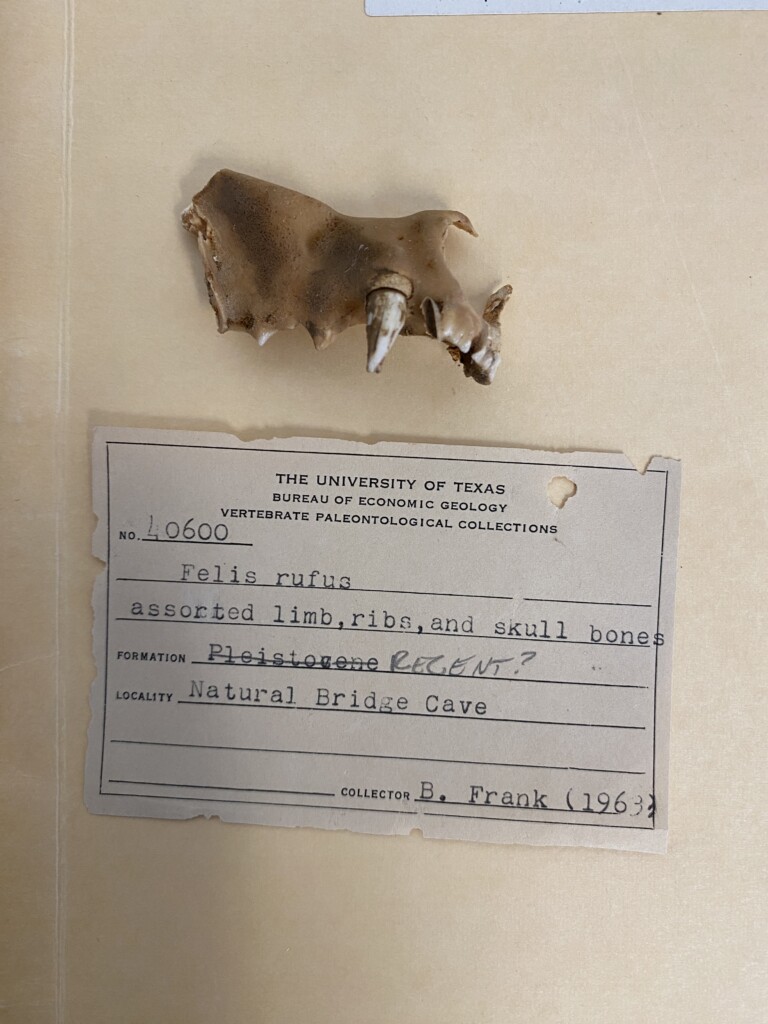
This is part of the original wildcat bone discovery from the 1960s found in Natural Bridge Caverns
Researchers have determined their age – about 11,500 years old – and have successfully extracted fragments of ancient DNA. They have also determined the cats are not a common bobcat, as was previously proposed, but likely a species of Neotropical cat, such as an ocelot, margay or jaguarundi.
“This puts these cats into a Neotropical group, which are all endangered today. Only ocelots are left in Texas,” said John Moretti, a doctoral student at the UT Jackson School of Geosciences leading the research. “This gets us into a really interesting group of cats – including a species that is now possibly extinct.”
Although the researchers don’t yet know what species of small cat slinked through the cave’s passageways thousands of years ago, they are closing in on answers.
Moretti is working with UT Assistant Professor Melissa Kemp, who is part of the Jackson School and the College of Natural Sciences, to apply state-of-the-art methods to prepare the ancient DNA fragments for sequencing that can definitively identify the cats. He is also conducting a systematic comparison of the bones from the Natural Bridge Cats to bones from Neotropical cats living today.
Ancient remains of Ice Age cats, recently discovered at Natural Bridge Caverns, offer scientists a rare glimpse into Texas’ prehistoric wildlife. These jawbones, carefully preserved and studied, help piece together the fascinating story of the region’s ancient ecosystem.
Discovering the cats’ identity could reverberate beyond the Texas cavern and popular tourist destination. The Natural Bridge Cats could serve as a literal skeleton key – providing a reference that could help with identifying the bones of ancient small cats around the world.
“They are prompting us to revisit questions about old specimens that have just been sitting on the shelf,” said Moretti. “Without them, there’s not an impetus to wrestle with these problems.”
The remains of the Natural Bridge Cats were found in two chambers called the Dungeon and the Inferno Room which are almost a mile from the current entrance of the cavern and 200 feet underground. Portions of the Dungeon cat were discovered in 1963 and brought to the UT collections for study and safe keeping.
John Moretti, with UT Jackson School of Geosciences, was part of the retrieval expedition at Natural Bridge Caverns
But in 2022, cavers discovered more cat bones in the Dungeon and a brand-new cat specimen in the Inferno Room. The openings into those two pit-like chambers are surrounded by small muddy pawprints that indicate it’s possible the cats fell into the chambers from above – and couldn’t get out.
“For decades, we’ve wondered about these bones – then we discovered the second cat. We have so many questions, including how these cats could have gotten so deep in the cave,” said Brad Wuest, president and CEO of Natural Bridge Caverns. “Discovery and exploration is at the heart of everything we do here at the caverns. Being involved with John and the team at UT Austin in this process of understanding more about the Natural Bridge Cats has been both rewarding and fascinating.”
In January 2023, Moretti led a recovery mission to bring the cats back to the surface after thousands of years underground. Research over the past year has helped to uncover some of the cats’ secrets.
Moretti matched the newly discovered bones in the Dungeon to the specimen sitting in the UT collections the past 60 years, showing that the two sets of bones came from the same skeleton. And two different dating techniques have placed the age of the cats in the ballpark of about 11,500 years ago. Radiocarbon dating on collagen extracted from the bones has the specimen at slightly older than that age. Uranium-thorium dating led by Jackson School scientists Staci Lowey and Alex Janelle on flowstone covering part of the specimen has it slightly younger.
But most important for figuring out the identity of the ancient cats is the successful extraction of ancient DNA. As expected, the DNA is in rough shape after spending thousands of years in a cave. But Moretti is hopeful about eventually being able to get a species identification.
“Like bones and other organic materials, DNA breaks down over time into smaller and smaller pieces,” Moretti said. “There’s still information stored in those fragments but it takes a lot of work to reconstruct and read the genetic code again.”
The DNA and collagen samples came from the Dungeon cat. The Inferno Room cat did not have DNA or collagen preserved. But based on the bones, Moretti thinks that what’s learned about one cat can be applied to the other.
“They’re the same shape and size,” Moretti said. “I feel confident that what we learn about the age and molecular identity of one skeleton is applicable to the other.”
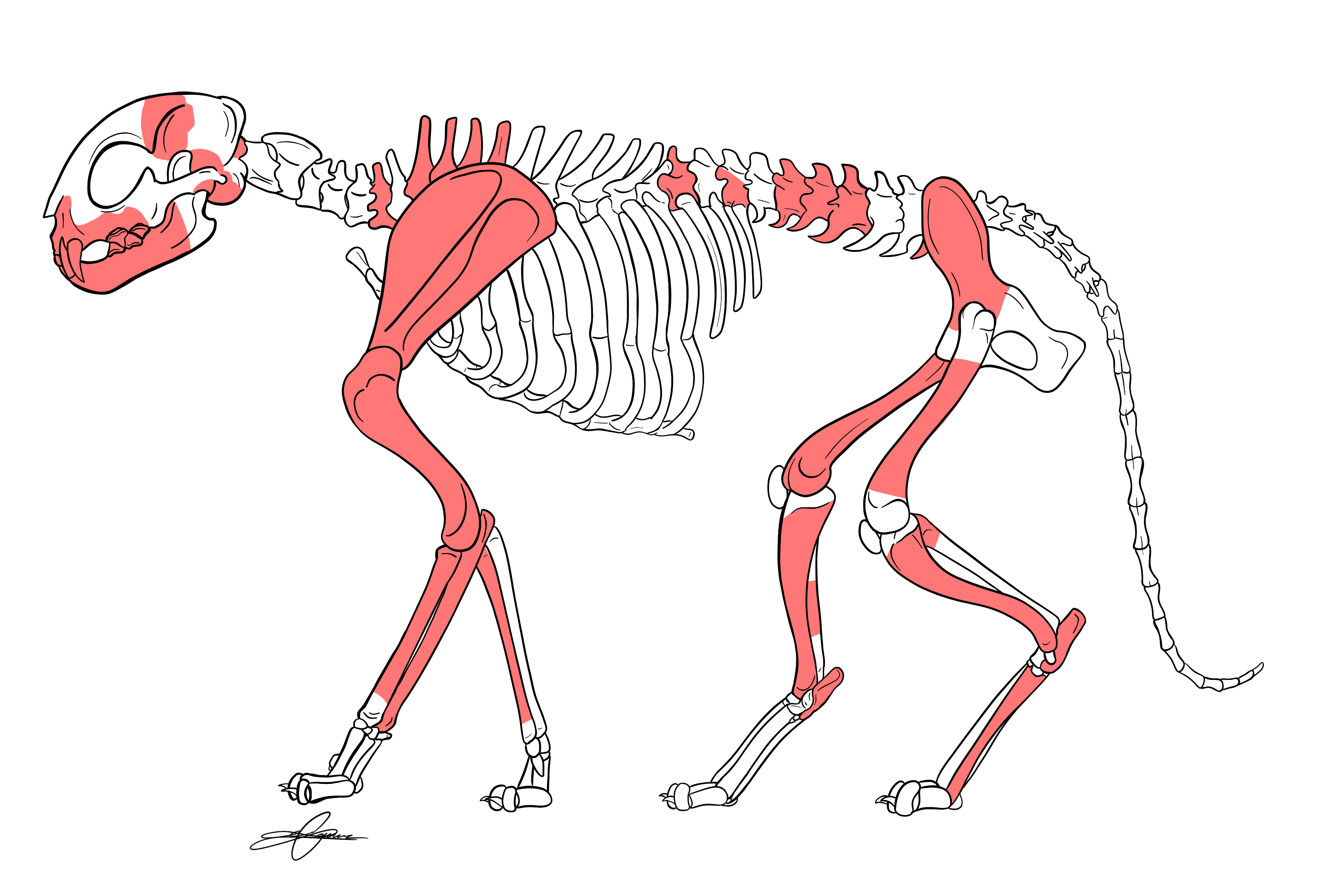
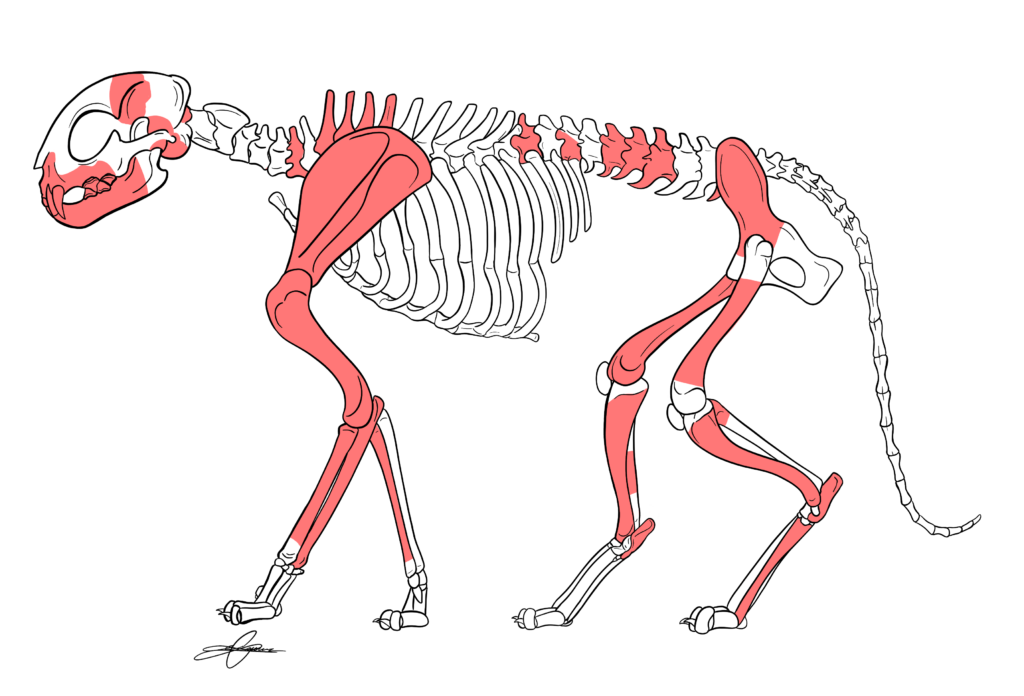
Having two ancient cats of the same kind found together – not to mention, with pawprints nearby – is incredibly rare. The cat from the Dungeon is the most complete specimen of a small Neotropical cat from the last ice age in North America. And together the two specimens make up a nearly complete skeleton with all its major parts in place.
Illustration of the skeletal remains of an ancient cat discovered at Natural Bridge Caverns, estimated to be around 11,500 years old. The red shading highlights the bones that were found intact, providing valuable insights into the physical structure of this possibly extinct Ice Age feline.
If the Natural Bridge Cats can be definitively identified as a certain species, their bones could help with classifying other ancient cat fossils – which are notoriously few in number and look very similar to one another.
For example, the bones brought back from the Dungeon in 1963 were identified in the UT collection as belonging to a bobcat until the additional bones brought back by Moretti disproved that.
The new bones are also raising interest around an old hypothesis that the Dungeon specimen is an extinct species of margay called a ‘river cat.’ The hypothesis was proposed by Lars Werdelin, a world-renowned expert on extinct cats based out of the Swedish Museum of Natural History, who examined the bones while conducting a national survey of small wildcat fossils in 1985.
Moretti is closely comparing the bones of the Natural Bridge Cats to skeletons from margays and other Neotropical cats on loan to UT from other institutions to identify what’s natural variation versus a distinguishing anatomical feature.
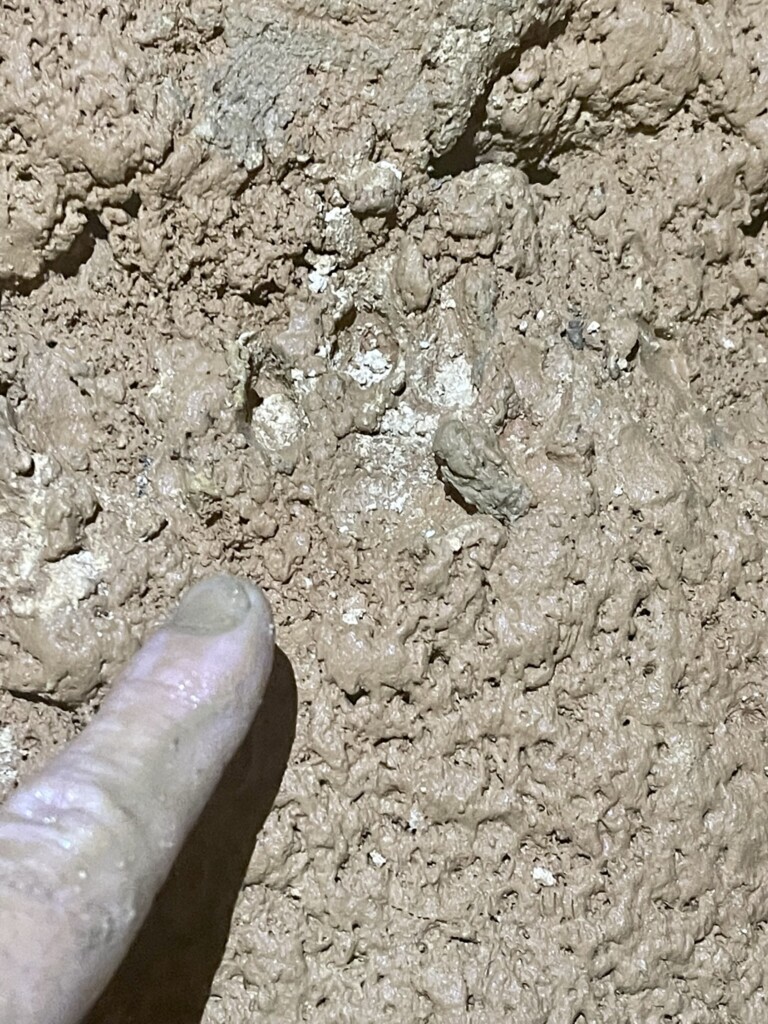
The research team is also deploying a custom-built imaging device designed to capture high-resolution, 3D images of the cat tracks. Data obtained from those images will provide a way of testing if those ancient paw prints were made by the Dungeon and Inferno Room cats.
Ancient tracks of a wildcat found in the mud within Natural Bridge Caverns
But until the DNA sequencing results are in, he expects the Natural Bridge Cats – who are now together in the UT collections – to continue keeping their identity a secret.
Our deepest thanks to John Moretti and Monica Kortsha from UT Austin for this wonderful update on our cave cats – who may have had a tough final journey in the cavern, but who now live on in scientific study!
The Back Story of Discovery of Wildcats in Natural Bridge Caverns
Overview
The University of Texas Jackson School of Geosciences and Natural Bridge Caverns and are launching a joint expedition in January to solve an ancient mystery: what kind wild cats left tracks/paw prints one mile from the entrance inside Natural Bridge Caverns – and are they the same wild cats whose bones lie at the base of a sheer drop in the cave?
The expedition to recover the bones, examine the trackways, and begin the process of study will be led by John A. Moretti from the Jackson School and Brad Wuest, president of Natural Bridge Caverns. It will involve complex ascending and descending rope work and crawling through tight muddy passages to get to the three sites where the bones have been undisturbed. The team will then carefully extract the bones and encase them to ensure they survive the trip back through the Cavern.
New Wild Cats Found In June of 2021, Wuest led an expedition to rig access pits and re-survey a large chamber and passage complex called the “Dungeon”. On that expedition the team found fossilized bones embedded in calcite formation. The team knew a wild cat skeleton had been discovered in the past on the Dungeon floor eighty feet below a series of pits however, the newly found bones were in a different location at the top of a slope of rubble and flowstone. Wuest contacted paleontologists with the Jackson School to learn more about the bones previously collected in Natural Bridge Caverns during the early 1960’s, to see if photos of the newly found bones could be identified and coordinate plans for their retrieval.
Finding Tracks
Following that outreach to the Jackson School, a highly unusual set of cat tracks were discovered in March of 2022 during a biological survey of the cavern, some tracks only ten feet from the mouth of the pit about eighty feet above the wild cat bones originally found on the Dungeon floor. The tracks are a full mile from the only known natural entrance into the cavern through completely dark and muddy passage, giant chambers, and many potential pitfalls and ½ mile from the closest commercial trail in Discovery Cavern. Within one week of discovering the cat tracks even more wild cat bones were discovered at the bottom of a sixty-foot-deep pit in a huge chamber called the Inferno Room. Tracks were also found not far from the top of this pit. Later yet, a third wild cat partial skeleton was found in a completely different area of the cave, closer to the entrance. The partial skeleton is nearly complete, a rare occurrence in specimens of small cats in the fossil record, and includes a partial skull, upper dentition, left and right dentaries, and all major limb elements.
History: Bones from 1960s
These are not the first set of wild cat bones discovered at Natural Bridge Caverns. The first were extracted in 1963 by early cave explorers, and initially identified by the University at Texas as a bob cat. However further research on wild cats has indicated that it’s possible that the bones are likely to be from an extinct form of a river cat, or potentially, a jaguarundi (which is now considered extinct in Texas). The 1963 recovered bones are part of the Jackson School’s collection; these new bones will be as well.